Salon SEO vs. PPC: Where Should Hair Salons Put Their Marketing Budget?
Salon Google Ads cost $8–20 per click — and a $120 haircut doesn't leave much room for error. Here's the honest math on SEO vs. PPC for salons, including when each channel actually makes sense.

Quick Answer: For most hair salons, SEO — especially map pack rankings via Google Business Profile — delivers better ROI than Google Ads. Salon PPC costs $8–20 per click; at a 5–10% conversion rate, you're paying $80–400 per new client. That math is tight on a $120 service. Build your organic presence first. Add PPC selectively for high-margin services or when you're launching a new location.
A dental implant is worth $4,000. A law firm client is worth $15,000. A haircut is worth $120. That single number — the average value of a salon service — is why the salon SEO vs. PPC question has a different answer than it does for almost every other local service vertical.
Salon Google Ads keywords cost $8–20 per click in 2026 (WordStream, 2026). Convert at the typical 5–10% landing page rate and you're paying $80–400 to book one new client. If that client books a $120 haircut and doesn't return, you lost money. If they rebook six times a year at $130 average, the math starts to work — but only just.
SEO doesn't have that problem. Once your salon owns a map pack spot for "hair salon [your city]," bookings compound month over month without a per-click cost that erodes your margin. This guide explains when each channel makes sense — and gives you the honest math to decide.
Key Takeaways
- Salon Google Ads keywords average $8–20/click; at a 5–10% landing page conversion rate, cost-per-new-client via PPC runs $80–400 (WordStream, 2026).
- The map pack captures roughly 44% of all clicks for "near me" local searches — and it's won through SEO, not paid ads (BrightLocal, 2025).
- 70–80% of salon clients start with a Google search; only 38% of salons have an active SEO strategy, making the map pack winnable for most independent studios (MarketingLTB, 2026).
- PPC makes economic sense for salons only in two situations: new-location launches and high-margin service campaigns (keratin, extensions, color correction).
- Local Service Ads (LSAs) are a better-fit paid channel for salons than standard Google Ads — pay-per-lead economics reduce cost-per-inquiry to $15–40.
What's the Actual Difference Between SEO and PPC for Salons?
Organic SEO is the process of earning visibility in Google's unpaid results — specifically the map pack (the three local listings that appear with a map) and organic blue-link results. It's earned through Google Business Profile optimization, citations, reviews, website quality, and local authority built over time. Cost-per-booking drops as your rankings mature.
PPC (pay-per-click) means paying Google directly to show your salon's ad when someone searches a relevant term. Google Ads (formerly AdWords) charges you each time someone clicks your ad — whether or not they book. Local Service Ads (LSAs) are a variant that charge per lead (verified phone call or message) rather than per click, which makes them more salon-friendly than standard search campaigns.
The fundamental economic difference is this: SEO is a compounding asset you build. PPC is rented visibility that disappears the moment you stop paying. Both drive bookings, but their cost trajectories are opposite — PPC stays expensive indefinitely, while organic cost-per-booking falls as your authority grows.
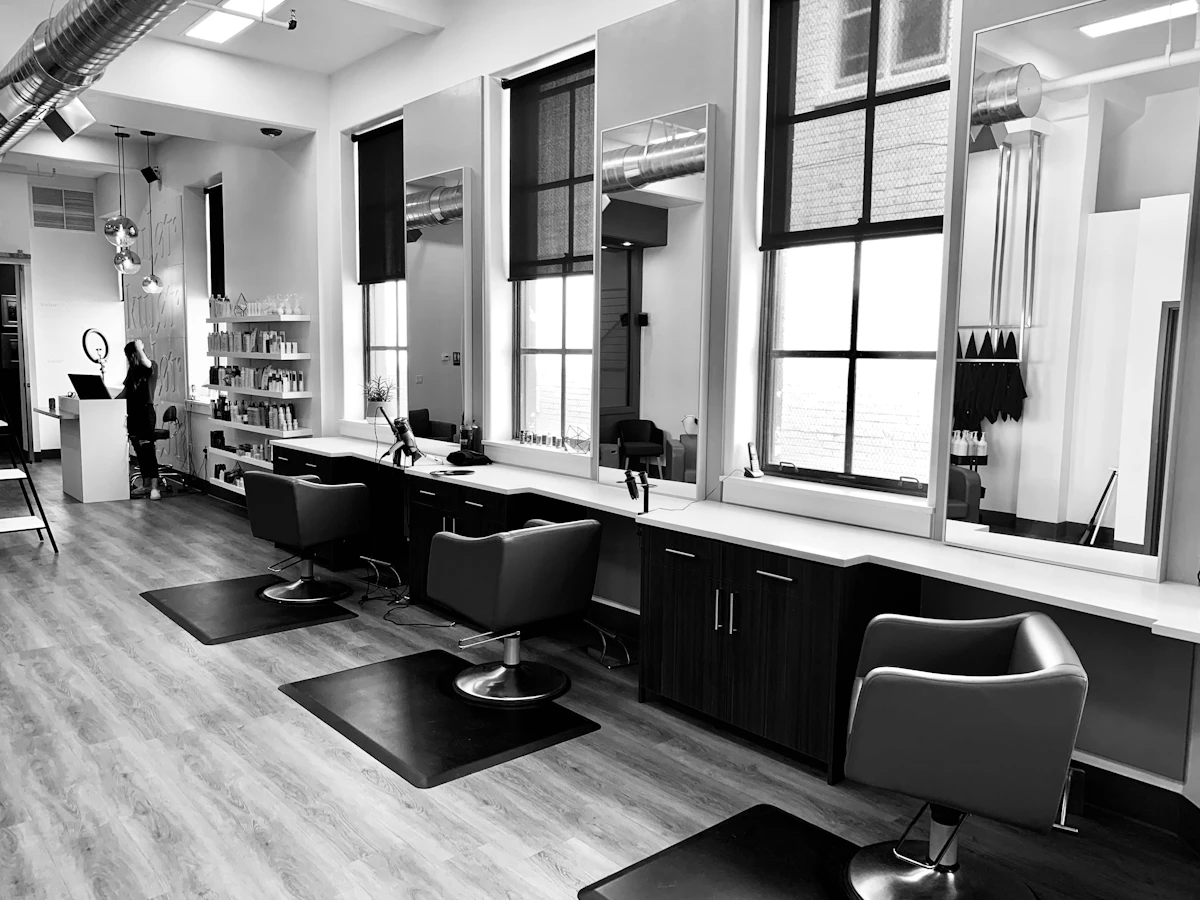
What Organic SEO Actually Does for a Hair Salon
Organic search and the map pack are how most salon clients find new studios. According to data from TheLocalGem, 70–80% of new salon clients begin with a Google search — "hair salon near me," "balayage [city]," or a specific service name (TheLocalGem, 2026). The map pack — those three highlighted local listings — captures roughly 44% of all clicks on those searches.
Ranking there costs nothing per click. What it costs is time and consistent work: optimizing your Google Business Profile (GBP), building beauty-directory citations on Yelp, StyleSeat, and Vagaro, maintaining review velocity (2–4 new Google reviews per month), and structuring your website with individual service pages for high-demand treatments.
Our finding: Salons that treat SEO as an ongoing operational discipline — not a one-time setup — see cost-per-new-booking fall to $30–80 by month 12. That's less than the tip on some of their services.
The rebooking rate also favors organic over paid. Clients who find a salon through organic search are typically higher-intent — they searched a specific service, found your reviews, and chose you deliberately. Clients acquired through paid ads have shorter decision windows and, in our experience, lower rebooking rates than clients who spent five minutes reading your reviews before booking.
SEO also builds a defensible asset. A salon with strong map pack presence and 150+ reviews doesn't lose those clients if it stops spending. A salon running Google Ads loses all paid visibility the day it pauses the campaign.
For a detailed breakdown of the SEO activities that drive map pack rankings, see our complete hair salon SEO guide.
What PPC Actually Gives a Hair Salon
Google Ads gives a salon one thing SEO can't: immediate visibility. The day your campaign goes live, your salon appears at the top of search results for whatever keywords you target. There's no three-to-six-month ramp. If you need bookings this week, paid search can deliver them.
PPC also gives you granular control. You can run ads only on Fridays and Saturdays when your stylists have open chairs. You can target specific neighborhoods. You can promote a single service — keratin treatments, for example — to the exact audience searching for it. That precision matters when you're managing capacity.
What we see in practice: Salons using Google Ads for general bookings — "haircut near me," "blow dry [city]" — rarely see profitable returns on low-margin services. Salons that run tight, service-specific campaigns (extensions, color correction, bridal packages) find much more favorable economics because the service value justifies the higher cost-per-click.
The limitation is structural. You're paying for every click — including the ones that don't book, the ones who click twice by accident, and the competitor's curious intern. And the moment your campaign goes dark, the bookings stop. There's no residual authority, no asset, no compounding return.
The Salon PPC Math — Run It Before You Spend
Here's the calculation every salon owner should do before launching Google Ads. It's not complicated, but most people skip it.
Typical CPC for salon keywords: $8–20 per click
Beauty and hair service terms average $8–14 per click for general queries ("hair salon near me," "balayage [city]"). Premium service terms — "keratin treatment," "tape-in extensions," "color correction" — run $15–25 per click (WordStream, 2026).
Typical landing page conversion rate: 5–10%
A well-built salon landing page with a clear booking CTA, service photos, and reviews converts at roughly 5–10%. That means 10–20 clicks per booked client.
The math:
| Scenario | CPC | Conversion Rate | Cost Per New Client |
|---|---|---|---|
| General haircut campaign | $10 | 8% | $125 |
| Balayage campaign | $14 | 7% | $200 |
| Keratin treatment campaign | $18 | 10% | $180 |
| Color correction campaign | $22 | 6% | $367 |
A $125 cost-per-client is borderline for a $120 haircut — you need that client to rebook at least twice before you break even on acquisition. A $200 cost-per-client for balayage makes more sense if your average balayage ticket is $220 and the client returns every 10–12 weeks.
Client lifetime value (LTV) changes the calculation. A salon client who visits every 8 weeks and spends $140 per visit generates roughly $910 per year. Against that LTV, even a $200 acquisition cost is acceptable — but only if your rebooking system is solid enough to capture that long-term value.
When PPC Actually Makes Sense for a Salon
PPC is the wrong default for most hair salons. But there are four situations where it's the right call.
1. Grand opening or new location launch. You have zero reviews, zero organic authority, and zero map pack presence. SEO takes 3–6 months to produce meaningful results. A focused launch campaign — $500–1,000/month for 60–90 days — generates early bookings while your organic presence builds. Think of it as paying for momentum, not a permanent channel.
2. High-margin service campaigns. Keratin treatments ($250–400), tape-in extensions ($500–900), bridal packages ($800–1,500), and color corrections ($200–500) have ticket values that justify $150–300 acquisition costs. Running a service-specific campaign for your highest-margin offering can be profitable where a general "haircut" campaign almost never is.
3. Seasonal capacity gaps. If you have open books in January or October — historically slow months for salons — a short-burst PPC campaign targeting gift card searches or seasonal treatments can fill the gap without a year-round ad commitment.
4. Testing a new service. Before investing in SEO content around a new service offering, PPC lets you validate demand quickly. A two-week campaign tells you whether "lash lift [city]" has bookable volume before you build a landing page, optimize for it, and wait four months for organic rankings.
When SEO Wins — Which Is Most of the Time
For an established salon that's been operating 12+ months, has a real client base, and wants sustained growth, SEO is almost always the stronger investment. Here's why.
The map pack is where most salon clients decide. Research from BrightLocal shows that 44% of local search clicks go to the map pack — the three listed salons that appear with a map before the organic results (BrightLocal, 2025). Those clicks are free. Owning a map pack spot for "hair salon [your city]" means paying nothing per click for the highest-intent traffic on Google.
Organic trust converts better. A client who finds your salon through organic search has already read your reviews, seen your photos, and chosen you over the others in the map pack. That pre-qualification process produces clients with higher rebooking rates than those who click an ad under time pressure.
The cost structure inverts over time. At month 1, SEO costs more per booking than PPC — you're paying a retainer and seeing limited results. By month 6–9, your cost-per-booking via SEO drops below what PPC costs. By month 12, the gap is significant. A salon spending $600/month on SEO that generates 8–10 new clients per month is paying $60–75 per new client — far below what those same clients would cost through Google Ads.
For a detailed look at what legitimate salon SEO costs and what's included, see our guide to salon SEO cost and pricing.

The Verdict: A Clear Recommendation
Most hair salons should start with SEO and add PPC selectively.
The specific order:
-
Fix your Google Business Profile first. Set the right primary category, build out 20+ specific service entries, upload weekly photos, and request 2–4 reviews per month consistently. This is free and produces the most impact per hour spent of anything in salon marketing.
-
Build citation consistency. Ensure your NAP data matches across Yelp, StyleSeat, Vagaro, Facebook, and the major directories. Inconsistent citations suppress map pack rankings even when your GBP is perfect.
-
Get to the map pack. For most independent salons outside top-5 metros, this takes 3–6 months of consistent work. Once you're there, protect that position with continued review velocity and GBP activity.
-
Then consider targeted PPC. If your budget allows ($1,200+/month total), add service-specific campaigns for your highest-margin offerings — not broad "hair salon near me" campaigns that bleed budget on low-value clicks.
-
Test Local Service Ads before standard Google Ads. LSAs charge per lead ($15–40), not per click. They're better-suited to salon economics than standard search campaigns and should be the first paid channel you try if PPC is in your plan.
The 70/30 split — 70% budget toward SEO and 30% toward targeted PPC — is a reasonable model for salons that have achieved map pack presence and want to accelerate growth for specific high-margin services.
Attribution: The Non-Negotiable for Either Channel
Whether you run SEO, PPC, or both, you need to know which channel is producing bookings. Without attribution, you're flying blind — you can't evaluate what's working or where to put your next dollar.
At minimum, a salon tracking attribution should have:
- Call tracking — a unique phone number per channel so you know whether a call came from organic search, a paid ad, or a directory listing. Services like CallRail start at $45/month.
- UTM parameters on any paid campaign links, so your booking software can attribute online bookings to the correct source.
- GBP Insights reviewed monthly — calls, direction requests, and website clicks from your Google Business Profile are the clearest signal of organic search performance.
- A "how did you hear about us?" field in your new-client intake form. Low-tech, but it catches bookings that digital tracking misses.
An SEO agency or marketing partner who can't show you attribution data from existing salon clients is a serious red flag. You should always know your cost-per-new-client by channel.
For more on building a local SEO foundation that produces trackable, attributable bookings, see our hair salon local SEO guide.
Frequently Asked Questions
Should a hair salon use SEO or Google Ads?
Most established salons should build SEO — specifically map pack rankings — before spending on Google Ads. Salon PPC costs $8–20 per click; at a 5–10% conversion rate, you're paying $80–400 per new client. That margin is tight on a $120 haircut. PPC makes sense for new salon launches and high-margin service campaigns like keratin treatments or extensions where the ticket value justifies the acquisition cost.
How much do Google Ads cost for hair salons?
Salon and beauty keywords average $8–20 per click in 2026. General queries like "hair salon near me" and "balayage [city]" sit at $8–14; premium service terms like "keratin treatment" or "hair extensions" can reach $15–25 per click (WordStream, 2026). Factor in a realistic 5–10% landing page conversion rate and you're paying $80–400 per booked client.
How long does salon SEO take to produce bookings?
Most independent salons see measurable map pack movement within 90–120 days of consistent SEO work — GBP optimization, citation cleanup, and steady review acquisition. Once in the map pack, cost-per-booking drops to $30–80 per new client by month 12, compared to $80–400 via PPC that doesn't fall without continuous optimization.
Are Local Service Ads worth it for salons?
Local Service Ads are pay-per-lead rather than pay-per-click, making the economics more salon-friendly. LSA leads for beauty services typically cost $15–40 per verified inquiry — significantly better than $80–400 per client through standard PPC. If you're going to run any paid traffic, LSAs are worth testing before launching a full Google Ads campaign.
Can a salon run both SEO and PPC at the same time?
Yes — and they work better together than either channel alone. Build your SEO foundation first (GBP, citations, reviews, service pages), achieve map pack presence, then layer in targeted PPC for high-margin services or to fill gaps while organic rankings mature. A 70% SEO / 30% PPC split works well for established salons with a marketing budget above $1,200/month.
Related Raftwise Guides
- Hair Salon SEO: The Complete Local Marketing Guide for 2026
- How Much Does Salon SEO Cost? An Honest Pricing Guide
- Hair Salon Local SEO: Ranking in the Map Pack
Sources
Written by Riya Gupta. Reviewed by the Raftwise Editorial Team for accuracy, clarity, and relevance to independent salons.
Frequently Asked Questions
More on Local SEO
Want to know where your next bookings are leaking?
We'll review the search and conversion gaps tied to this topic, then show you the highest-priority fixes for your salon.