GEO for Salons: How to Get Your Salon Recommended by AI Search
When someone asks ChatGPT "best balayage salon in [city]," AI either names your salon or it doesn't. Here's how to be the one it names — and why your Instagram portfolio is invisible to every AI system that matters.
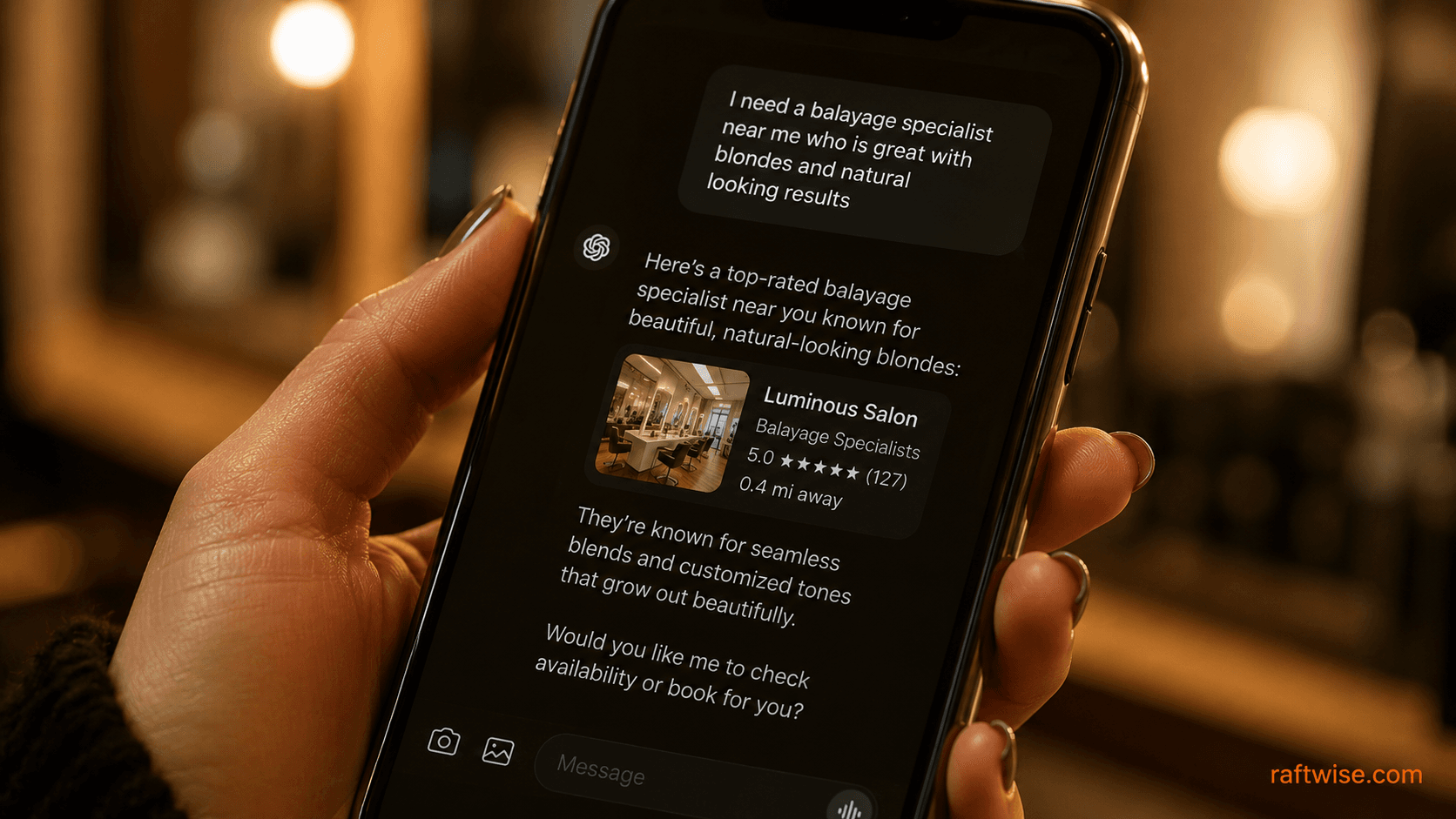
Quick Answer: GEO (Generative Engine Optimization) for salons is the practice of structuring your website, reviews, and Google Business Profile so that AI systems — ChatGPT, Perplexity, Google AI Overviews — name your salon when someone asks for the best in your area. AI can't browse Instagram. It reads structured, crawlable text. If your expertise lives only on your feed, AI doesn't know it exists.
Your Instagram looks great. Clients have commented on your balayage work for years. Your DMs are full of booking requests from people who found you through a tagged reel.
None of that matters when someone opens ChatGPT and types, "What's the best balayage salon in [city]?"
AI assistants can't see your portfolio. They can't browse your feed, watch your reels, or read the 400-word caption you wrote about color theory. They read your website, your Google Business Profile, your reviews — and they extract structured facts. A salon with a beautiful Instagram and a thin website is, to every AI system that matters, invisible.
Key Takeaways
- AI assistants — ChatGPT, Perplexity, Claude, Google AI Overviews — cannot crawl Instagram. Your portfolio is invisible to AI unless it exists as crawlable website text.
- Google AI Overviews now appear in roughly 45% of searches (Search Engine Land, 2024). Local recommendation queries are among the fastest-growing segment.
- AI systems extract named entities — salons, stylists, specific services — from structured content. Pages, not lists. Named people, not "our team."
- Five changes drive most of the GEO lift for salons: service-specific pages, stylist bio pages, FAQ content, reviews that mention specific services, and LocalBusiness schema markup.
- GEO infrastructure strengthens traditional SEO at the same time. You are not building two separate things.
What GEO Actually Is
Generative Engine Optimization (GEO) is the practice of making your salon the one AI recommends when someone asks for the best in your area.
Traditional SEO gets you ranked in a list of ten blue links. GEO gets you named as the answer. When a potential client asks Perplexity "top-rated hair salons near downtown [city]" or asks ChatGPT "where should I go for a color correction in [city]," the AI produces one or two specific names. GEO is the work of being one of those names.
The mechanics are different from traditional search. AI systems don't just look at which page ranks highest — they extract specific facts from crawlable text, weigh them against signals from reviews and structured data, and synthesize a recommendation. Structured, specific, entity-rich content wins. Generic content and social media feeds lose.
How AI Decides Which Salons to Recommend
AI systems aren't guessing. They're extracting.
When ChatGPT or Perplexity generates a local salon recommendation, they draw from a specific set of sources: your website content, your Google Business Profile data, reviews that mention specific services by name, and structured data (schema markup) that tells the AI what your salon does in machine-readable format.
What AI looks for:
- Named entities — your salon's name, your stylists' names, the specific services you offer, your neighborhood
- Structured facts — hours, pricing, address, service descriptions in crawlable text
- Service-specific mentions — reviews and pages that use exact service terms: "balayage," "keratin treatment," "color correction," not just "great work"
- Authority signals — how many sources mention your salon, how consistently the same facts appear, how recently the content was updated
- Schema markup — machine-readable data that explicitly identifies your salon type and service offerings
An AI system reading a well-structured salon website can extract: this is a hair salon, it offers balayage and keratin treatments, it has a stylist named Sarah who specializes in lived-in color, it's located in [neighborhood], it has a 4.8-star rating with 140 reviews. That's a citable entity. A salon whose entire expertise lives in Instagram captions gives AI nothing to work with.
Why Instagram Doesn't Help With GEO
This is the part most salon owners don't want to hear.
Instagram is a closed ecosystem. AI assistants — ChatGPT, Perplexity, Claude, Google AI Overviews — do not have access to Instagram's content. They cannot crawl your grid, view your reels, read your captions, or index your saved highlights. The platform explicitly blocks external crawlers. Your portfolio, your process, your five years of transformation photos — none of it is visible to AI search systems.
The same is true for Facebook posts, TikTok videos, and Pinterest boards. Social platforms are gardens with walls. AI reads the open web.
The fix is not to stop using Instagram — it still drives discovery through human networks. The fix is to duplicate your expertise onto your website in a format AI can actually read. That means service pages that describe what you do in specific language. Stylist bios that state specialties and experience. FAQ content that answers the exact questions clients ask before booking. Schema markup that structures all of this for machine consumption.
The Five GEO Changes That Matter Most for Salons
1. Service-Specific Pages
A single "Services" page with a list of treatments does very little for AI. AI cites pages, not lists.
Create a dedicated page for each high-demand service: Balayage. Color Correction. Keratin Treatments. Extensions. Highlights. Each page should open with a clear, specific description of the service — what it is, how long it takes, what results to expect, and the price range. Include a short FAQ on that page addressing the questions clients ask before booking that service.
When someone asks Perplexity "where can I get a keratin treatment in [city]," and your salon has a 600-word page specifically about keratin treatments at your location, you become a citable source. A salon whose website mentions "keratin" once in a services list does not.
2. Stylist Bio Pages
AI systems extract named entities. A named stylist with a clearly stated specialty is far more citable than "our talented team."
Build a bio page for each stylist. Be specific: "Sarah specializes in lived-in blondes and balayage, with 8 years of experience in color correction and precision cutting." List their training, their specialties, and the types of clients they work best with. Include a photo.
This matters for two reasons. First, many clients search for a specific stylist by name after seeing their work on Instagram — a bio page captures that search. Second, AI systems that recommend specialists by name pull from structured bio content, not social profiles.
3. FAQ Content
FAQs are one of the most effective GEO formats for salons because they map directly to how people phrase AI queries.
Write FAQ content around the specific questions your clients ask before booking:
- "How long does a balayage appointment take?"
- "What's the difference between highlights and balayage?"
- "How do I care for keratin-treated hair at home?"
- "How often should I come in for a root touch-up?"
- "Can I get color correction in one session?"
These questions mirror AI query patterns almost exactly. When Perplexity or Google AI Overviews pulls the answer to one of these questions, they pull it from a page that answered it clearly — and they cite the source. Your salon page becomes the cited source.
Add FAQ schema markup to these pages. It tells AI systems the question-answer structure explicitly, making extraction more reliable.
4. Reviews That Mention Specific Services
Reviews are one of the primary signals AI systems use to understand what a salon is known for. A review that says "great experience!" contributes almost nothing to GEO. A review that says "I came in for a color correction after a box-dye disaster and left with the most beautiful lived-in blonde" is an entity-rich AI signal.
You cannot write reviews for your clients, and you should not ask for specific language in a way that feels scripted. But you can make it natural. When a client is thrilled at the end of an appointment, ask them to share what they got done. "If you love your balayage, we'd really appreciate a Google review — just tell people what you came in for and what you thought." That's enough.
Over time, a review corpus where dozens of reviews mention "balayage," "keratin," "color correction," and "extensions" by name tells AI exactly what your salon is known for. A review corpus of generic compliments tells it nothing.
5. Schema Markup
LocalBusiness and HealthAndBeautyBusiness schema markup is the most direct way to tell AI systems what your salon is and what it does.
At minimum, your schema should include:
- Salon name, address, phone, URL, hours, geo coordinates
- Business type:
LocalBusiness→HealthAndBeautyBusiness hasOfferCatalogwith each service listed by name and description- Aggregate rating pulled from your review data
priceRangeto indicate your tier
This structured data is machine-readable. It doesn't require AI to parse prose — it can extract the facts directly from structured markup. Salons with complete schema markup show significantly higher citation rates in AI-generated local recommendations than those without it.
[INTERNAL-LINK: complete GBP optimization guide for salons → /salons/blog/salon-google-business-profile-optimization]
Your GBP Is Also GEO Infrastructure
Google AI Overviews — the AI-generated summaries that now appear at the top of roughly 45% of Google searches — pull heavily from Google Business Profile data. Your GBP is not just a local search tool; it's a primary data source for AI.
A fully optimized GBP with accurate categories, a complete services section, recent photos, and active review collection is also GEO infrastructure. The same completeness that helps you rank in the map pack helps AI extract facts about your salon for generated answers. The two systems share the same data.
This means GBP optimization work is never wasted. Filling out your services section with 15+ specific treatment entries doesn't just help you appear in "keratin treatment near me" searches — it gives Google AI Overviews concrete service data to reference when someone asks for balayage specialists in your area.
[INTERNAL-LINK: hair salon local SEO guide → /salons/blog/hair-salon-local-seo-guide]
GEO vs. Traditional SEO for Salons
GEO and traditional salon SEO share infrastructure. A well-structured website with specific service pages, strong GBP optimization, and a consistent review strategy is the foundation of both.
The emphasis differs. Traditional SEO rewards relevance signals and domain authority to rank your pages on a results list. GEO rewards directness and specificity — the ability for AI to extract a clear, confident fact. A page that opens with a definitive answer to a common question gets cited more than a page that buries the answer in the third paragraph.
Where GEO specifically adds to traditional SEO:
- Specificity over generality — named stylists, named services, named neighborhoods instead of generic "we do it all" language
- Answer-first structure — the key fact in the first sentence, not built toward slowly
- Schema markup — explicit structured data that AI doesn't have to infer from prose
- Review signals — service-specific mentions that create entity associations AI can extract
Investing in GEO almost always strengthens your traditional SEO at the same time. The same service-specific page that gets cited by ChatGPT also ranks better in traditional search for "balayage [city]" than a generic services list does. The work compounds.
[INTERNAL-LINK: hair salon SEO complete guide → /salons/blog/hair-salon-seo-guide]
What to Expect: A Realistic Timeline
GEO is not a switch you flip. It's infrastructure you build.
Most salons that implement all five changes — service pages, stylist bios, FAQ content, service-mentioning reviews, and schema markup — start appearing in AI-generated local recommendations within 3 to 6 months. GBP-driven changes that feed Google AI Overviews can show results faster, sometimes within 4 to 8 weeks.
The salons that see the fastest GEO results are those that already have strong traditional SEO foundations. If you already rank in the map pack and have 80+ Google reviews, adding GEO-specific structure to your website and schema gives AI systems confidence to cite you immediately. If you're starting from scratch on both, build the traditional foundation first, then layer GEO on top.
The longer-term picture: AI search queries are growing fast. As more clients ask ChatGPT or Perplexity for local salon recommendations rather than typing into a search bar, the salons that built GEO infrastructure early will have an advantage that compounds. The salons that wait will be trying to catch up to competitors who are already being named.
FAQ
What is GEO for salons?
GEO (Generative Engine Optimization) for salons is the practice of structuring your website, Google Business Profile, and online presence so that AI systems — ChatGPT, Perplexity, Google AI Overviews — recommend your salon when someone asks for the best in your area. AI extracts structured facts from crawlable text. If your expertise lives only on Instagram, AI doesn't know it exists. See the full answer in our FAQs.
Does Instagram help a salon get recommended by AI search?
No. AI assistants cannot crawl Instagram. They read your website, your GBP, your reviews, and structured data. A salon with a beautiful Instagram feed and a thin website is invisible to AI-generated recommendations.
How long does it take to appear in AI recommendations?
Most salons see results in 3 to 6 months after implementing service-specific pages, stylist bios, FAQ content, review strategy, and schema markup. GBP-driven changes that influence Google AI Overviews can show results faster — sometimes within 4 to 8 weeks.
What schema markup should a salon use for AI?
Use LocalBusiness → HealthAndBeautyBusiness schema with your salon details, a hasOfferCatalog listing specific services, aggregate rating, price range, and geo coordinates. Add FAQPage schema to any FAQ content.
Is GEO different from traditional salon SEO?
They share the same infrastructure — strong website, GBP, and reviews. GEO adds specificity: named stylists, named services, answer-first structure, and schema markup. Investing in GEO almost always improves traditional SEO rankings at the same time.
Related Raftwise Guides
- The Complete Local SEO Guide for Independent Hair Salons — GBP categories, beauty directory citations, review velocity, Instagram as a local signal
- Salon Google Business Profile Optimization — Services with prices, photos, the booking CTA, and review response templates
- Hair Salon SEO: The Complete Guide for 2026 — Every layer of salon SEO from GBP setup through website structure and online booking integration
Sources
- Search Engine Land — Google AI Overviews: Prevalence Study 2024
- Princeton / KDD 2024 — GEO: Generative Engine Optimization — Research on how content structure influences AI citation rates
- BrightEdge — AI Search Behavior Report 2025 — AI Overviews reducing organic clicks by up to 58%
- Semrush — AI Overviews Local Business Data 2024 — Local recommendation queries in AI search growth
Written by Riya Gupta. Reviewed by the Raftwise Editorial Team for accuracy, clarity, and relevance to independent salons.
Frequently Asked Questions
More on Local SEO
Want to know where your next bookings are leaking?
We'll review the search and conversion gaps tied to this topic, then show you the highest-priority fixes for your salon.