Hair Salon Google Reviews: How to Get More, Reply Well, and Turn Them Into Bookings
A new client checks your reviews before she checks your prices. How a salon earns a steady flow of recent Google reviews without discounts or begging, how to reply to the bad ones, and why 20 recent reviews matter more than 200 old ones.
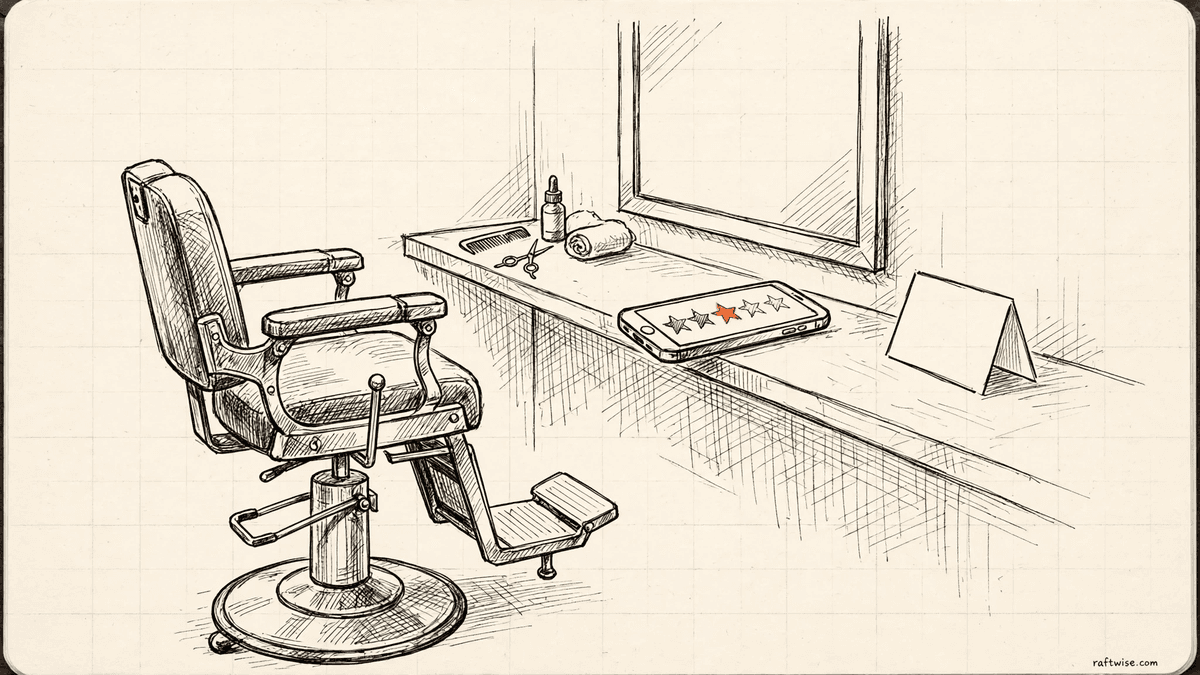
Quick Answer: Hair salon Google reviews are earned at the mirror moment, not in a follow-up campaign. Have the stylist ask in one sentence when the client sees the finished result, send one text with a direct review link within two hours, and reply to every review within two working days. Never offer a discount for a review and never ask only happy clients: Google prohibits both. Recent reviews matter more than total count, so the goal is a steady weekly rhythm, not one big push.
A new client decides about your salon in an order most owners get backwards. She does not start with your prices or your Instagram. She searches for a salon near her, sees three names on Google, and reads the reviews. The salon she books is usually the one whose reviews sound like her: same hair problem, same worry, fixed by a named stylist, recently.
Salon owners know reviews matter. The part that stalls them is the asking. In stylist forums, the same worry comes up again and again, paraphrased here: asking for a review feels needy, clients mean to leave one and forget, and the few who remember are not always the happy ones. So most salons ask occasionally, apologetically, and get a review profile that grows by accident.
This guide replaces the accident with a system: when to ask, what to send, what Google forbids, how to reply, and how reviews turn into bookings.
What a new client actually checks
BrightLocal's 2026 Local Consumer Review Survey sets the shape of it. In that survey, 41% of consumers said they always read reviews when browsing for a business. 47% said they would not use a business that has fewer than 20 reviews. 74% said they only care about reviews written in the last three months. And 31% said they would only use a business rated 4.5 stars or higher.
Read those four numbers as a salon owner and three conclusions follow.
First, there is a floor. Below roughly 20 reviews, a large share of searchers quietly rule you out before your website gets a chance. Getting from 8 reviews to 25 is not vanity. It is crossing the line where strangers start considering you at all.
Second, recency beats history. A salon with 200 reviews and nothing new since last year reads as a business that was good once. A salon with 45 reviews and three in the last fortnight reads as busy now. Clients book the salon that looks alive.
Third, the rating bar is high but not perfect. Clients expect 4.5 or better from the salon they choose, and a profile of nothing but five stars, with replies that all sound stamped from one template, does not clear that bar more safely than a 4.7 with a few honest three-star reviews answered well. What convinces is a pattern: recent, specific, and responded to.
Ask at the mirror moment
Every appointment has a moment when the client sees the finished cut or colour, turns her head, and reacts. That reaction is the review. She has already written it out loud: the colour is exactly the photo, the fringe finally sits right, nobody has cut it like this before.
The system starts there. The stylist who did the work says one sentence: if you loved it, a Google review really helps other people find us, and we will text you the link so it takes a minute. Said by the stylist, at that moment, this does not feel needy. It feels like the end of a good appointment, because it is attached to something the client just said herself.
Two details make it work. The ask belongs to the stylist, not to a sign and not to the receptionist, because the gratitude is to a person. And the sentence is agreed across the salon, so every client hears the same simple version and no stylist has to improvise a speech they are embarrassed by.
One link, one text, within two hours
Willingness dies in friction. A client who has to find your listing, scroll, and sign in will finish the review another day, which means never. Remove every step between her intention and the review box.
Your Google Business Profile gives you a short review link that opens the review form directly. Put that link in three places: a QR card at each station and at the desk, for the client who wants to do it now; your booking system's follow-up message, if it allows a custom link; and a text you send from the salon within two hours of the appointment, thanking the client by name and carrying the link.
One text. Not a sequence. The client who gets three reminders learns to ignore your number, and the one who was mildly disappointed now has a reason to say so publicly. A single prompt while she is still showing people her hair catches the goodwill at its peak.
What Google forbids, and why it matters
Two shortcuts circulate in salon marketing advice, and both put the listing at risk.
The first is paying for reviews in kind: 10% off your next visit, a free treatment add-on, or entry into a draw if you leave a review. Google's review policies prohibit incentives for reviews, full stop. Reviews earned this way can be removed, and a listing built on them can be penalised. You will still find articles recommending the discount route. A discount is not a loophole. It is the example the policy is written about.
The second is gating: checking privately whether the client was happy, sending the happy ones to Google, and steering the unhappy ones to a feedback form nobody reads. Google prohibits this too, and it is easier to spot than owners think, because a gated profile has a shape: a sudden wall of five stars and silence everywhere else.
The honest route is also the effective one. Ask everyone, the same way, for an honest review. Your average will be a little lower than a gated profile's. Your profile will still be there next year, and strangers trust a 4.7 earned openly over a 5.0 that looks arranged.
Reply to every review like a future client is reading
Because she is. The reply's real audience is not the reviewer. It is the next fifty searchers deciding whether your salon handles itself well.
For a positive review, reply within two working days and make it specific. Name what the client named: the balayage, the stylist, the rescue of a home colour job. "Thanks for the lovely review" pasted forty times tells a reader the replies are a chore. One sentence that proves a person read it tells her the salon pays attention, which is the whole promise of a good salon in miniature.
For a negative review, keep to a short pattern. Thank them for saying it. State plainly that this is not the standard you work to. Invite them to call the salon so you can put it right. Then stop. Do not retell the appointment, do not mention what the client did, do not name the stylist, and do not write the second reply if they answer back in public. Take it to the phone. A calm, brief, generous reply under a harsh review regularly wins the reader over to the salon's side, because it shows exactly how the salon behaves when something goes wrong.
For a review that is fake or from someone who was never a client, say so in one calm sentence for the record, and report it to Google through your profile. Then leave it. Chasing it publicly helps nobody.
Turn the reviews you have into the next booking
Reviews compound when you use them beyond the listing. Quote the specific praise, with the client's first name where they used it publicly, in your profile posts and on your website's service pages: the colour correction story belongs on the colour page, next to the booking button, where a nervous searcher is deciding. When ten reviews praise the same stylist's curly cuts, that is a service page, a photo set, and a profile post waiting to happen.
Once a month, read the pattern rather than the score. What do clients keep praising? That is your marketing, in their words. What keeps drawing complaints: the wait, the parking, a rushed finish on Saturdays? That is an operations fix that will raise every future review at once. Our guide to getting more salon clients covers the wider system reviews sit inside, and our salon Google Business Profile guide covers the listing itself, field by field.
If you would rather not watch all this yourself
The review system above runs on one agreed sentence, one text, and a monthly half hour. Keeping your profile, your website, and your reviews pulling in the same direction is the wider job, and it is the job Raftwise exists to do. The Hub is your website. The Engine is the work that gets you found on Google and in AI answers. The plan is $299 a month, billed yearly, with a monthly report showing how many new clients your site sent you. Book a free consultation and we will tell you what we would fix first.
Related Raftwise guides
- Salon Google Business Profile Optimization: Why You Are Losing to Chains
- How to Get More Salon Clients: The Systems That Actually Fill Your Chair
- The Complete Local SEO Guide for Independent Hair Salons
Sources and further reading
Written by Riya Gupta. Reviewed by the Raftwise Editorial Team for accuracy, clarity, and relevance to independent salons.
Frequently Asked Questions
Want to know where your next bookings are leaking?
We'll review the search and conversion gaps tied to this topic, then show you the highest-priority fixes for your salon.