What Is GEO and Why Every Dentist Needs to Understand It in 2026
Generative Engine Optimization is how you get recommended by AI search tools like ChatGPT, Perplexity, and Google AI Overviews. Here's what it means for dental practices in 2026.

Quick Answer: GEO (Generative Engine Optimization) is the practice of optimizing your dental practice's online presence to be recommended by AI tools like ChatGPT, Perplexity, Google AI Overviews, and Apple Intelligence. It requires publishing specific, credentialed, factual content about your procedures; maintaining citation consistency across directories; and building review presence across multiple platforms — all actions that also reinforce traditional local SEO.
When a patient asks ChatGPT "who's the best dentist for dental implants in Austin?" and gets a confident, specific recommendation — that's a search channel that barely existed two years ago and is now used by hundreds of millions of people monthly.
It's called Generative Engine Optimization, or GEO. And while most dental practices have barely figured out traditional local SEO, the early movers in GEO are already capturing patient attention from a channel growing faster than any other in search history.
What Is GEO?
Generative Engine Optimization (GEO) is the practice of optimizing your online presence to be recommended, cited, or referenced by AI-powered search tools — including:
- Google AI Overviews — AI-generated summaries appearing at the top of Google search results, now present on roughly 15% of all queries
- ChatGPT Search — OpenAI's search-integrated ChatGPT, which passed 400 million weekly active users in early 2026 and now retrieves real-time web content
- Perplexity AI — an AI search engine that synthesizes and cites sources; default search on Samsung Galaxy devices globally
- Apple Intelligence — launched with iOS 18.1 and integrated into Siri and Apple Maps; surfaces local business recommendations directly in iPhone search
- Meta AI — integrated into Instagram, Facebook, and WhatsApp search; used by over 600 million monthly active users for local recommendations
- Claude — Anthropic's AI assistant, increasingly used for local recommendations and practice research
- Bing Copilot — Microsoft's AI-integrated search
These tools work differently from traditional search engines. Instead of displaying a list of links for the user to click, they synthesize information and generate a response — often including specific recommendations with reasoning. For a patient searching "best dentist for dental anxiety in Seattle," a generative AI tool might respond: "Several practices in Seattle are noted for their approach to anxious patients. [Practice Name] in Capitol Hill has been mentioned specifically for their sedation dentistry program and patient-centered approach..."
That kind of specific, contextualized recommendation drives action. Patients who receive an AI-generated recommendation have already been through a filtering process — they're more primed to act than patients who see a search results list and need to self-evaluate.
How AI Tools Decide Who to Recommend
Traditional SEO is governed by algorithms that weight factors like domain authority, keyword relevance, backlinks, and click signals. AI-generated recommendations work differently — and in some ways, more fairly for independent practices.
AI tools primarily synthesize information from:
Web content they've been trained on or can retrieve in real-time. If your practice website has clear, detailed, accurate information about what you do, who you serve, and where you're located, that information can be incorporated into AI-generated responses.
Structured data and citations. Practices that appear in authoritative directories (Healthgrades, Zocdoc, Yelp, dental association directories) with consistent, accurate information are more likely to be surfaced by AI tools that retrieve structured business data.
Review platforms. AI tools increasingly integrate review signals from Google, Yelp, Healthgrades, and Zocdoc. A practice with strong ratings and review volume across multiple platforms has a higher AI visibility surface.
Content that demonstrates specific expertise. This is where GEO differs most significantly from traditional SEO. AI tools are much better than keyword-matching algorithms at identifying whether content represents genuine expertise. A dental implant page written by an experienced implant dentist — with specific clinical detail, realistic outcomes, and honest discussion of candidacy requirements — is more likely to be cited by an AI tool than a generic implant marketing page.
Why GEO Matters for Dental Practices in 2026
The patient research process has shifted. AI search is no longer a novelty used by early adopters — it's the default research interface for a large and growing share of patients.
ChatGPT alone passed 400 million weekly active users in early 2026. Perplexity became the default search on Samsung Galaxy devices globally. Apple Intelligence is pre-installed on every iPhone running iOS 18.1+, which is the majority of active iPhones as of mid-2026. Meta AI is available in every Instagram, Facebook, and WhatsApp search bar, reaching users who would never describe themselves as "AI search users."
For dental practices, this matters because:
- AI answers reduce zero-click attrition for you. When an AI tool recommends your practice by name, the patient has a more specific intent than someone who saw your listing in a search results page. Conversion from AI-referred patients is anecdotally higher, though practice-level data will vary.
- The competitive landscape is less established. Unlike Google Maps, where entrenched competitors with hundreds of reviews are hard to displace, AI visibility is more easily influenced by content quality today. The window for being an early mover is real.
- GEO work compounds local SEO. The optimization actions that build GEO presence — content quality, citation consistency, review volume — are the same signals that drive map pack rankings. There's no tradeoff.
What GEO Optimization Looks Like for Dental Practices
Publish clear, factual, expert-attributed content
AI tools privilege content that is specific, accurate, and attributable to a credible source. Every service page should include:
- The dentist's name and credentials in context ("Dr. [Name], who completed a residency in implant dentistry at [institution]...")
- Specific procedure detail that demonstrates clinical knowledge, not marketing language
- Honest discussion of candidacy, risks, recovery, and realistic outcomes
- Clear location signals — city, neighborhood, and zip code in natural context
The AI model reading your page needs to be able to unambiguously answer: what does this practice do, where are they, and what evidence is there that they're good at it?
Ensure citation consistency across authoritative directories
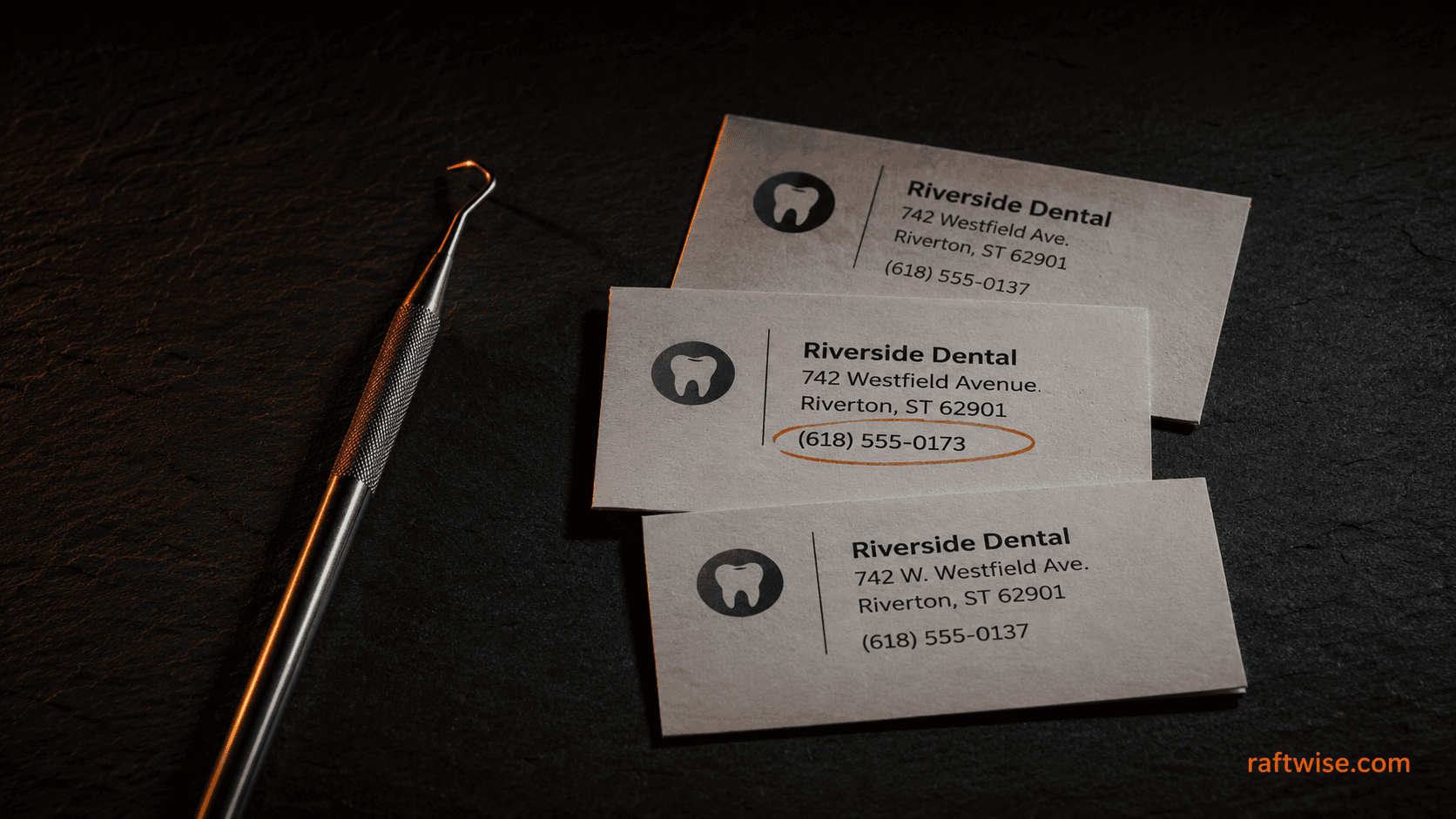
AI tools retrieve information from multiple sources and synthesize it. Inconsistencies in your name, address, and phone number across directories create conflicting signals that reduce the confidence with which an AI tool will recommend you.
Audit and standardize your information across:
- Google Business Profile
- Apple Maps (increasingly important for Apple Intelligence)
- Healthgrades
- Zocdoc
- Yelp
- WebMD / Vitals
- Your state dental association directory
- Any specialty organization directories (AAID for implants, AAO for orthodontics)
Consistency isn't just a traditional SEO signal — it's a trust signal for AI retrieval systems.
Build review presence across multiple platforms
Traditional SEO heavily favors Google reviews. AI search tools draw from a broader review landscape — Yelp, Healthgrades, Google, and Zocdoc reviews all feed into the signals that AI tools use to evaluate local healthcare providers.
A practice with 180 Google reviews and 15 Yelp reviews is better positioned for AI recommendation than one with 200 Google reviews and nothing elsewhere. Expand your review collection strategy to include Healthgrades and Zocdoc, which are specifically cited by AI tools responding to healthcare provider queries.
Create FAQ and Q&A content that matches conversational queries
Traditional SEO optimizes for short keyword phrases ("dental implants cost Seattle"). AI search tools respond to natural language questions ("how much do dental implants cost in Seattle and what affects the price?").
Structure content on your service pages and blog to match conversational queries:
- FAQ sections with specific, accurate, detailed answers (not hedged marketing non-answers)
- "What to expect" content that walks through the full patient experience
- Comparison content ("dental implants vs. dentures: which is better for my situation?")
This format aligns with how patients phrase queries to AI tools and with how AI tools structure their synthesized responses.
Allow AI crawlers in your robots.txt
Ensure your robots.txt explicitly allows the major AI crawlers:
GPTBot(OpenAI)OAI-SearchBot(OpenAI search)ClaudeBot(Anthropic)PerplexityBot(Perplexity)Applebot(Apple Intelligence)Google-Extended(Google AI training)
Practices that accidentally block AI crawlers — through overly restrictive legacy robots.txt rules — are invisible to AI training and retrieval, regardless of how strong their content is.
How to Measure Your GEO Visibility
Unlike traditional SEO where rank trackers give you daily position data, GEO measurement requires a manual process — for now.
Monthly AI visibility test protocol:
- Open each major AI tool (ChatGPT, Perplexity, Google AI Overviews, Apple Intelligence via Siri)
- Ask 5–8 patient-style questions specific to your market: "best dentist for dental implants in [city]", "dentist near [neighborhood] accepting new patients", "who does Invisalign in [city]"
- Record: whether your practice is mentioned, which source was cited, the exact date
- Track month-over-month using a simple spreadsheet
Results vary by tool, by location context, and by query phrasing. Don't draw conclusions from a single test — trend over 3+ months.
Signals that GEO work is improving your visibility:
- Your practice begins appearing in AI answers for procedure-specific queries before location-generic ones
- The sources AI tools cite shift from third-party directories to your own website
- New patient intake forms show "heard about us from AI / ChatGPT / Google AI"
The last signal is underreported because most dental intake forms still only list "Google, referral, insurance directory, other." Adding "AI search / ChatGPT / Perplexity" as an intake option now means you'll have data when it becomes a meaningful share of new patient acquisition.
The Timeline for GEO Results
GEO is a longer game than map pack optimization. AI model training cycles mean that new content may take weeks or months to meaningfully influence AI-generated recommendations. Real-time retrieval (used by ChatGPT Search, Perplexity, and Bing Copilot) is faster — content can influence AI responses within days of being indexed.
The optimization actions that build GEO presence also reinforce traditional local SEO. Content quality, citation consistency, and review volume are ranking signals in both systems. There's no tradeoff; GEO work compounds your existing local SEO investment.
The question isn't whether AI search will be a meaningful patient acquisition channel for dental practices. It already is. The question is whether your practice will be the one that AI tools recommend when your future patients ask.
Related Raftwise guides
- The Content Strategy That Fills a Dental Website's Calendar for 12 Months
- Should Dentists Be on Social Media? An Honest Assessment
Sources and further reading
- Google: Tips to improve your local ranking
- Google: Guidelines for representing your business
- OpenAI: ChatGPT usage statistics (February 2026)
- Search Engine Land: Perplexity becomes default search on Samsung Galaxy devices
- Apple: Apple Intelligence overview — iOS 18
- BrightLocal: Local Consumer Review Survey 2025
Written by Riya Gupta. Reviewed by the Raftwise Editorial Team for accuracy, clarity, and relevance to independent dental practices.
Frequently Asked Questions
More on Local SEO


Want to know where your next patients are leaking?
We'll review the search and conversion gaps tied to this topic, then show you the highest-priority fixes for your practice.