Local SEO for Dentists: The Complete Guide to Ranking Where Patients Search
Most dentists confuse local SEO with general SEO. They are entirely different systems. This guide explains exactly how local search works for dental practices — and what it takes to rank in the map pack.

A patient picks up their phone, types "dentist near me," and sees three practices before anything else. That block of three — the map pack — captures roughly 44% of all clicks on a dental search results page, according to BrightLocal's local search studies. If your practice isn't in it, you're invisible to nearly half the patients searching for you right now.
Local SEO for dentists is the process of optimizing your practice's online presence so Google ranks you in the map pack and local organic results for searches made near your location. Unlike general SEO — which targets broad informational or national queries — local SEO operates on a proximity-plus-relevance-plus-prominence model that determines which three practices appear for a given searcher at a given moment.
Key Takeaways
- The map pack captures ~44% of dental search clicks (BrightLocal, 2025) — organic results split the rest
- Google ranks local results on three factors: proximity, relevance, and prominence
- Your Google Business Profile is the single highest-leverage asset in local SEO
- NAP consistency across directories is one of the most impactful fixes most practices never make
- Meaningful ranking movement takes 3–6 months — not days
Why Local SEO Is Completely Different from Regular SEO
Most of what you've read about SEO applies to informational content — blog posts competing for national or global queries. That's not your patient's search behavior.
When someone needs a dentist, they don't search "best composite bonding materials 2026." They search "dentist near me," "family dentist [city]," or "emergency dental [neighborhood]." Every one of those searches has local intent — the searcher wants a result nearby, not a well-written article from a practice in another state.
Google responds to local intent with an entirely different algorithm layer. Instead of ranking pages primarily by domain authority and content depth, it ranks business listings by three distinct signals:
- Proximity — How close is this practice to where the searcher is right now?
- Relevance — How well does the listing match what the searcher asked for?
- Prominence — How well-established and trusted does Google consider this practice?
You can't change your proximity. Your practice is where it is. But relevance and prominence are entirely within your control — and that's where most independent practices have significant gaps.
Our finding: The majority of independent dental practices we audit have claimed their GBP but left the Services section empty or populated with generic category names. That single omission creates a measurable relevance gap that corporate DSO profiles — which typically receive centralized optimization — exploit in every competitive zip code.
Why Independent Dentists Can't Afford to Ignore Local Search
You didn't spend eight years in school to lose patients to a corporate clinic with a billboard budget. But that's exactly what happens when a DSO opens two miles away with a fully optimized GBP, 200+ Google reviews, and location-specific landing pages on a high-authority domain — while your practice sits with a half-complete profile and 18 reviews from 2022.
This condition has a name: Invisible Practice Syndrome (IPS) — the state of having a high-quality practice that patients can't find because the local search signals are too weak to surface it in the map pack.
The symptoms are specific: a slow Tuesday schedule, new-patient inquiries dropping despite no change in service quality, and a vague sense that "Google isn't working" for you. The cause isn't Google. The cause is a local SEO gap that DSOs fill systematically while independent dentists often don't know exists.
Google's own data shows that 76% of people who conduct a local mobile search visit a physical location within 24 hours. Among those searches, "dentist near me" and related dental queries consistently rank among the highest-intent local searches measured — the person searching has already made the decision to go somewhere. The only question is whether that somewhere is your practice or a competitor's.
How the Map Pack Actually Works
The map pack is the block of three business listings — with star ratings, addresses, and phone numbers — that appears at the top of Google search results for local queries. Google pulls these listings from Google Business Profile (GBP), the free platform where businesses manage their local listing.
Your GBP is not a secondary directory. For local search, it's the primary signal source. Google uses it to determine your categories, services, location, hours, photos, review count, and review recency — all of which feed directly into the three ranking factors.
The Three Ranking Factors, Applied to Dentistry
Proximity is straightforward: a practice closer to the searcher has an inherent advantage. This is why you'll rank more easily for patients in your immediate neighborhood than for patients across town. You can't optimize your way out of a proximity disadvantage — but you can dominate proximity within your natural service radius.
Relevance is where most practices lose ground. Google determines relevance by matching the searcher's query to your GBP categories, services, and website content. If a patient searches "Invisalign dentist [city]" and your GBP doesn't list Invisalign as a service — or your website has no Invisalign page — Google has weak evidence to rank you for that query, regardless of how close you are.
Prominence is the hardest to build and the most durable once built. Google uses review volume, review recency, citation consistency, website authority, and external mentions to assess how established and trusted a practice is. A practice with 150 reviews, consistent directory listings, and a well-linked website has stronger prominence signals than a newer practice regardless of proximity.
What Dentists Usually Get Wrong
The single most common error is treating GBP as a one-time setup task. Claiming the profile, adding hours and a phone number, and walking away. What that leaves unconfigured: the full Services section, secondary categories (Cosmetic Dentist, Emergency Dental Service), attributes like "Accepts New Patients," Q&A responses, and a photo library — all of which are active ranking signals.
See the detailed breakdown in our Google Business Profile guide for dentists.
What Is NAP Consistency — and Why It Matters
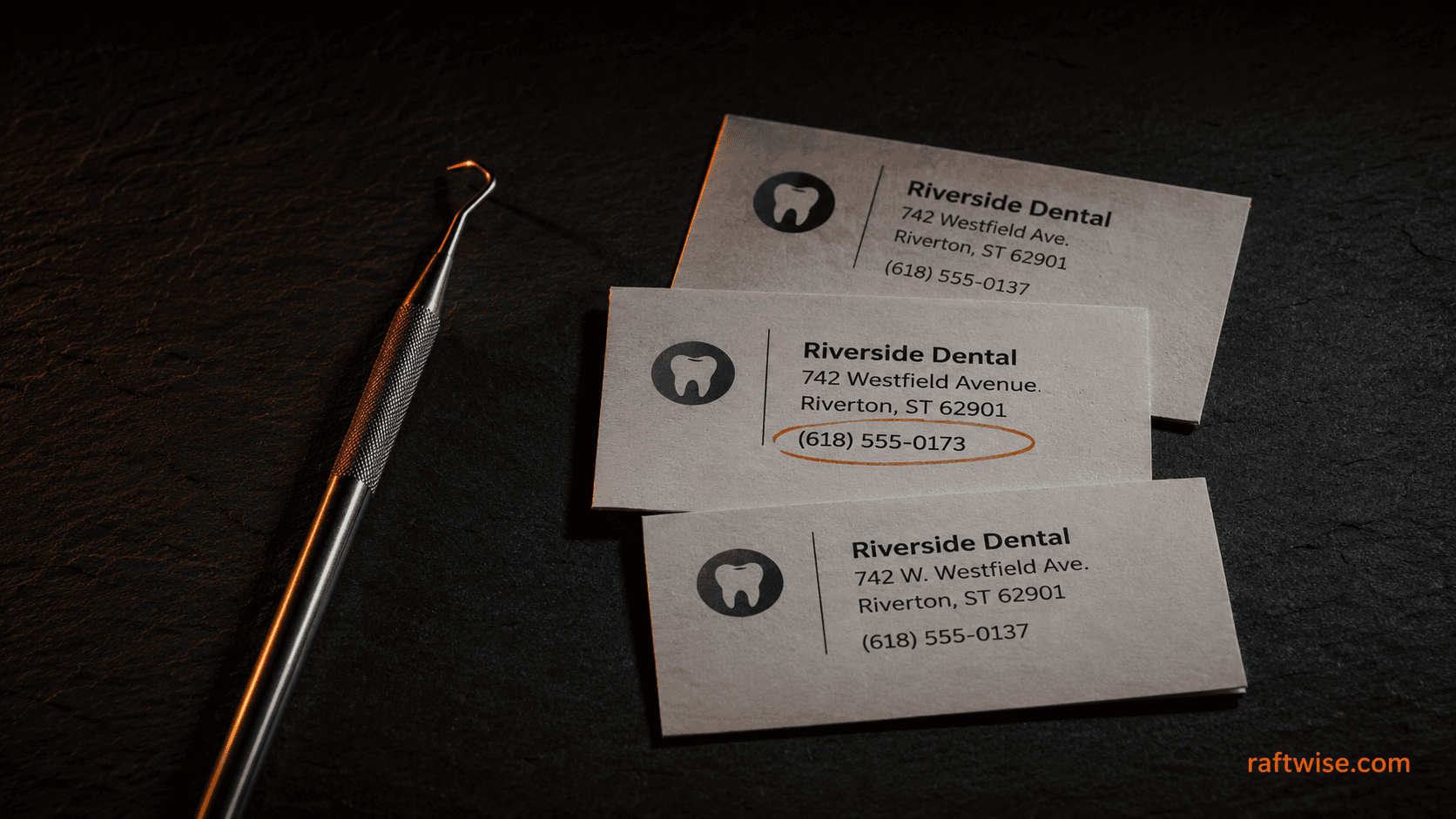
NAP consistency means your practice's Name, Address, and Phone number appear identically across every online directory, listing, and citation. Not approximately the same. Identically.
This matters because Google verifies your business data by cross-referencing it against dozens of external sources. When those sources disagree — "Suite 200" on your GBP vs. "#200" on Yelp vs. "Ste. 200" on Healthgrades — Google's confidence in your data drops. That reduced confidence translates directly into weaker prominence signals and lower map pack rankings.
The Most Common NAP Mistakes in Dental Practices
- Suite number formatting variations — "Suite 100," "#100," and "Ste 100" are different strings to a machine
- Phone number with and without area code — some directories auto-format, creating inconsistency
- Old addresses after a move — even a move within the same building creates orphaned citations
- Practice name variations — "Smith Family Dentistry" vs. "Smith Family Dental" vs. "Dr. Smith Family Dentistry"
- Tracking phone numbers — using a call-tracking number in your GBP while your real number appears elsewhere
Every one of these creates what Google's algorithm treats as conflicting data about a different business. The fix is an audit: find every place your practice is listed, identify inconsistencies, and correct them one by one, starting with the highest-authority sources.
Our dental citation building guide covers the full audit process and the priority order for fixing inconsistencies.
How to Optimize Your Google Business Profile for Map Pack Rankings
Your GBP is the highest-leverage asset in local SEO. It's free, it directly controls what appears in map pack results, and most practices have left significant optimization on the table.
Categories
Set your primary category to "Dentist" — not "Dental Clinic," not "Dental Office." The primary category carries the most ranking weight. Add secondary categories for every specialty you genuinely offer: Cosmetic Dentist, Orthodontist, Pediatric Dentist, Oral Surgeon, Emergency Dental Service. Each secondary category expands the query surface Google can match your profile against.
Services
This is the section most practices skip. Every procedure you offer should appear here with its specific name — "Dental Implants," "Same-Day Crowns," "Invisalign Clear Aligners," "Teeth Whitening" — not generic umbrella terms. Add 2–3 sentence descriptions to each. Google reads these descriptions to match your profile to relevant patient searches.
Photos
Practices with photos receive 42% more direction requests than those without, per Google's own data. Upload exterior, interior, team, and technology photos. Add new photos monthly — freshness signals matter. Skip the stock photography that doesn't show your actual practice.
Posts and Q&A
Post at least twice per month. Proactively seed your Q&A section with questions patients actually ask — about insurance, parking, new patients, and common procedures. Google surfaces Q&A answers in the knowledge panel, and unanswered questions often get crowdsourced responses from strangers.
For a section-by-section optimization checklist, see our full GBP guide for dental practices.
How Reviews Affect Your Local Rankings
Reviews are not just a reputation signal — they are a ranking signal. Google's local ranking algorithm weights reviews across three dimensions: volume, recency, and response rate.
Volume is the raw count. More reviews signal a more established, prominent practice. But volume without recency loses its signal strength over time.
Recency is where most practices lose ground. If your last review came in four months ago, Google reads your profile as less active than a competitor getting two reviews per week. Practices that implement a systematic ask-after-appointment process — a text with a direct review link sent 24 hours post-visit — typically see 3–5x their previous monthly review volume.
Response rate signals active management. Practices that respond to every review, positive and negative, show Google (and prospective patients) that a real team is monitoring the profile. Unresponded reviews, especially negative ones, send the opposite signal.
Our finding: The average independent dental practice in a mid-size city has 34 reviews with the most recent arriving 11 weeks before the audit. The leading DSO competitor in the same zip code has 127 reviews with 4 added in the past 30 days. That recency gap is a larger ranking factor than most dentists realize — and it's entirely fixable with a consistent patient outreach process.
A 4.8-star average with 28 reviews does not outperform a 4.6-star average with 110 recent reviews in most markets. Star rating matters, but it's a smaller factor than most dentists assume. Volume and recency are the higher-leverage levers.
On-Page Local Signals: Your Website's Role in Map Pack Rankings
Your website doesn't just help you rank in organic search — it directly strengthens your map pack prominence. Google cross-references your GBP with your website to confirm that the practice it's ranking is legitimate and relevant.
City and Service Landing Pages
Every major service area and specialty you offer should have a dedicated page on your website. "Dental Implants [City]" as a page title — not a footnote on a general services page. These pages give Google something to verify relevance against when a patient searches "dental implants [city]."
If you serve multiple neighborhoods or suburbs, a location page for each with genuine, specific content (not copy-paste pages with the city name swapped) strengthens your visibility in those areas.
Schema Markup
Schema markup is structured data code added to your website that tells Google exactly what your practice is, where it's located, and what it offers. For dental practices, the relevant schema types are LocalBusiness, Dentist, and MedicalOrganization. This markup creates a direct machine-readable connection between your website and your GBP data.
Without schema, Google infers your practice details from your page text. With schema, you tell Google directly.
Location in Title Tags
Include your city name naturally in title tags on your core pages. "Family Dentist in [City] | [Practice Name]" tells Google — and patients — where you are. This is one of the oldest local SEO signals and still one of the most consistent.
Citations and Directory Listings: Building Local Prominence
Citations are any online mention of your practice's NAP data. Google uses citation volume and consistency to assess prominence — the more authoritative sources that independently confirm your practice exists at a specific location with a specific phone number, the stronger the signal.
The priority stack for dental citations:
- Core directories — Google Business Profile, Yelp, Bing Places, Apple Business Connect, Facebook
- Healthcare-specific directories — Healthgrades, WebMD/Vitals, Zocdoc, RateMDs
- Dental-specific directories — your state dental association, 1-800-Dentist, find-a-dentist tools from insurance carriers
- Data aggregators — Data Axle, Foursquare, Neustar Localeze (these feed hundreds of downstream directories)
- Local directories — your city's chamber of commerce, local business associations
The goal isn't to be listed everywhere. The goal is accurate, consistent data on the directories that patients actually use and that Google's algorithm weights as authoritative.
For a full walkthrough of the audit and build process, see our dental citation building guide.
What to Realistically Expect from Local SEO (The Honest Timeline)
Local SEO is not a fast tactic. Commit to this expectation before starting: meaningful map pack movement typically takes 3–6 months for a practice with no existing optimization, and that timeline assumes consistent execution throughout.
Here's what the timeline generally looks like:
Month 1–2: Foundation work — GBP audit and completion, NAP consistency fixes, citation audit, review process implementation. No ranking movement yet. You're correcting data that's been sending weak signals for months or years.
Month 2–4: Review volume starts building. Google begins registering the corrected citations. You may see GBP impressions and call volume increase before ranking position visibly changes. This is the phase most practices abandon — don't.
Month 4–6: Ranking movement becomes measurable. Practices typically start appearing in the map pack for peripheral queries first (specific procedures, nearby neighborhoods) before gaining ground on the primary "dentist near me" query.
Month 6+: Compounding returns. A well-maintained GBP with consistent reviews and accurate citations becomes progressively harder for competitors to displace. The practices that rank in the top two map pack positions in most mid-size cities have been maintaining these signals consistently for 12–24 months.
Practices that do the foundation work and quit after 90 days typically see no lasting gain. The practices that move from position 6 or 7 in local results to the top-3 map pack are almost always the ones that maintained the process for a full 12 months — even during the months when nothing seemed to be changing.
If you're getting impatient after month two, read the diagnostic in our map pack ranking guide to confirm you're working on the right variables.
Frequently Asked Questions
How long does local SEO take to work for a dental practice?
Meaningful movement in local rankings typically takes 3–6 months for practices starting from scratch. Practices with a claimed GBP, consistent NAP data, and an active review process can see directional improvement in 60–90 days. Overnight results aren't realistic, and any service promising them should be avoided.
What is the most important factor for dental map pack rankings?
Google weighs three factors: proximity, relevance, and prominence. Proximity is fixed — you can't move your practice. Relevance comes primarily from a complete Google Business Profile with accurate categories and services. Prominence is built through reviews, citations, and an authoritative website. Relevance and prominence are where most independent practices have the most room to improve.
Does my dental website affect my map pack ranking?
Yes. Your website is a prominence signal. Google cross-references your GBP data against your website to confirm relevance. Practices with dedicated service and city pages rank higher in the map pack than those with thin or generic sites. Schema markup (LocalBusiness and Dentist schema) also strengthens the connection between your website and your GBP.
How many Google reviews does a dental practice need to rank?
Requirements vary by market. In a low-competition suburb, 25–40 reviews with a 4.5+ average may be sufficient. In a dense metro, you may need 100+ with consistent monthly additions to stay competitive. Volume matters, but recency matters equally — 5 reviews in the past 30 days signals more than 80 reviews with nothing new in six months.
What is NAP consistency and why does it matter for dentists?
NAP stands for Name, Address, and Phone number — the three core data points that identify your practice across the web. NAP consistency means those three fields are formatted identically across every directory, citation, and listing. Inconsistencies (different suite number formats, old phone numbers, abbreviated street names) tell Google your data is unreliable, which weakens your local ranking signals.
Related Raftwise Guides
- Why Your Dental Practice Doesn't Rank in the Map Pack (And How to Fix It) — The full diagnostic for practices that have claimed their GBP but still aren't ranking
- The Complete Google Business Profile Guide for Dentists (2026) — Every GBP section explained, with the settings most practices never touch
- The Dental Practice Guide to Local Citations — How to audit NAP consistency, fix duplicates, and build authoritative directory coverage
Sources
- BrightLocal. (2025). Local Consumer Review Survey. https://www.brightlocal.com/research/local-consumer-review-survey/
- Google. How Google determines local ranking. Google Business Profile Help. https://support.google.com/business/answer/7091
- Google. Be found in local searches on Google. Google Business Profile Help. https://support.google.com/business/answer/9213451
- BrightLocal. (2025). Local Search Industry Survey. https://www.brightlocal.com/research/local-search-industry-survey/
- Google. How to improve your local ranking on Google. https://support.google.com/business/answer/7091
- Moz. (2025). Local Search Ranking Factors. https://moz.com/local-search-ranking-factors
Written by Riya Gupta. Reviewed by the Raftwise Editorial Team for accuracy, clarity, and relevance to independent dental practices.
Frequently Asked Questions
More on Local SEO


Want to know where your next patients are leaking?
We'll review the search and conversion gaps tied to this topic, then show you the highest-priority fixes for your practice.