Chiropractor Social Media Marketing: What Actually Works in 2026
Most chiropractors waste time on social media by posting the wrong content to the wrong platform. Here's a channel-by-channel breakdown of what actually drives new-patient inquiries.
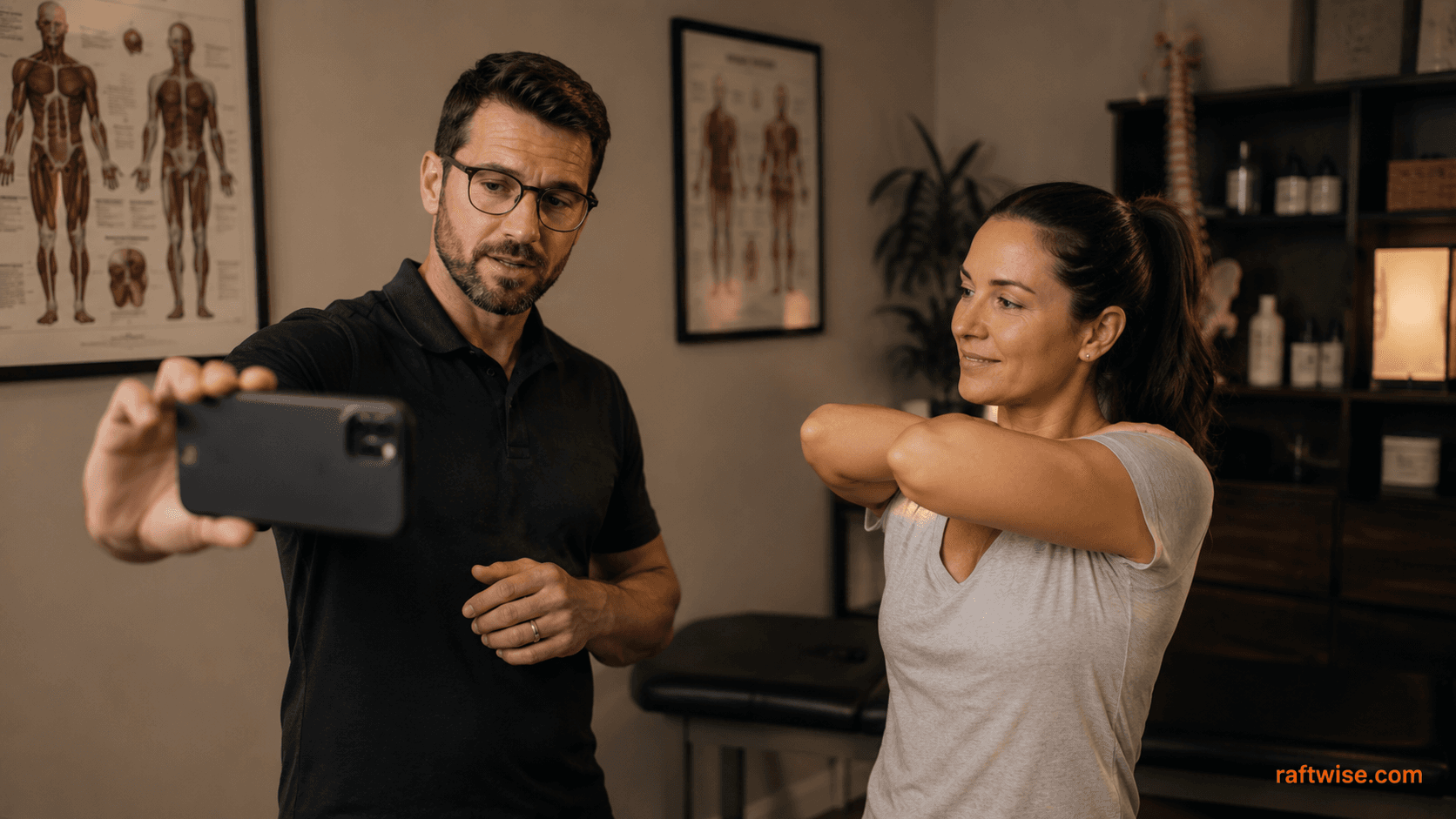
Quick Answer: Most chiropractors post randomly across every platform and wonder why social media doesn't bring in new patients. The answer isn't posting more — it's matching each platform to a specific job. Facebook builds community trust and reactivates dormant patients. Instagram educates and converts younger patients. Google Posts feed directly into local search visibility. TikTok reaches under-35s with high engagement but requires sustained video effort.
More than half of patients use social media to research healthcare providers before booking (The American Chiropractor, 2025). Yet most chiropractic practices post a spine illustration on Tuesday, a motivational quote on Thursday, and then go quiet for two weeks. That's not a strategy. It's busywork.
This guide gives you a practical, platform-by-platform breakdown of what actually drives new-patient inquiries — including exactly what to post, how often to post it, and what to stop doing immediately.
Key Takeaways
- Healthcare accounts on Instagram average 3.5% engagement; Facebook averages 1.3% — but each platform serves a different role (Hootsuite, 2026)
- Google's November 2025 update pulls Business Profile post content into AI-generated local summaries, making weekly posts a direct local SEO lever
- TikTok delivers 5.96% engagement for chiropractic content vs. Instagram's 0.83% — but the audience is predominantly under 35 (SocialInsider, 2026)
- Carousels are the top-performing Instagram format for healthcare at 4.5% engagement (Hootsuite, 2026)
- 82–89% of patients research providers online before booking, making consistent social activity a trust signal, not just a traffic channel (Stethon Digital, 2026)
Why Most Chiropractic Social Media Doesn't Work
Chiropractic practices fail on social media for one reason: they treat every platform like a bulletin board. The average chiropractic practice posts the same content — spine tips, promotions, office hours — across Facebook, Instagram, and Google with no platform-specific strategy. Healthcare engagement rates reflect this mismatch, with Facebook averaging just 1.3% and most practices performing well below that (Hootsuite, 2026).
The platforms aren't the problem. The content-platform mismatch is.
Facebook's algorithm rewards local community content and shares, not clinical infographics. Instagram's algorithm rewards saves and carousel completion rates, not single images. Google Posts aren't social at all — they're a local search signal dressed up as content. Treating them all identically is like using the same adjustment technique on every patient regardless of their complaint.
What works is assigning each platform a job — and only asking it to do that job.
Our finding: Chiropractic practices that assign a single primary function to each platform (rather than duplicating content across all of them) report stronger engagement within 60 days, because platform algorithms surface content that users on that platform actually respond to.
The practices that get the most from social media are usually posting less overall — but with more intentionality. Two well-crafted Facebook posts per week outperform seven mediocre ones. A single educational Reel on Instagram will outlast five static promotional images. Platform specificity matters more than volume.
Facebook: Community Trust and Patient Reactivation
Facebook remains the most effective social platform for chiropractic practices targeting patients over 35, with a healthcare engagement rate of 1.3% overall — but album-format posts and community-specific content regularly hit 3.8% (Hootsuite, 2026). That gap tells you everything: the format and framing of content matters as much as the platform itself.
Facebook's primary job for a chiropractic practice is two things: building local community trust and reactivating patients who haven't booked in 90-plus days.
Content that works on Facebook:
- Behind-the-scenes posts (team introductions, clinic tours, "a day in the practice")
- Community involvement (sponsoring a local event, announcing a health fair)
- Patient success stories — written format, with explicit written HIPAA consent and no identifiable health details shared without authorization
- Educational posts framed as community questions ("How many of you work at a desk all day? Here's what that does to your spine after 5 years.")
- Seasonal health tips tied to local context (back-to-school posture reminders, winter activity injury prevention)
What not to do on Facebook:
Don't run discount-based promotions as your primary content. Discount ads attract price shoppers. Patients who come in for a $39 new-patient special are statistically less likely to complete a care plan than patients who came in because they trusted your practice from months of educational content. Healthcare CPM on Meta rose roughly 70% from January 2025 to January 2026 (mychiropractice.com, 2026) — paid reach is expensive. Earn organic trust first.
Post cadence: two to three times per week. Highest engagement days for healthcare are Tuesday through Thursday, mid-morning.
For a full picture of how local trust signals interact with your online presence, see the chiropractic online reputation management guide.
Instagram: Treatment Education and Younger Patient Acquisition
Instagram delivers 3.5% average engagement for healthcare accounts — nearly three times Facebook's rate — making it the right platform for practices targeting patients under 40 (Hootsuite, 2026). But the content type matters enormously: carousels average 4.5% engagement in healthcare, while single static images lag behind. If you're posting single images on Instagram and wondering why engagement is flat, the format is the problem.
Instagram's job is treatment education and new-patient acquisition from a younger demographic.
Content that works on Instagram:
- Posture correction carousels (5-8 slides, starting with "Is this you?" framing, ending with a simple correction)
- Spinal health tip series (a recurring format patients can anticipate builds followers faster than one-off posts)
- Short Reels (15-30 seconds) showing a specific adjustment or decompression technique with simple narration
- Before/after posture photos — with patient consent documented via a signed social media release form
- Auto accident recovery education: what to do in the first 72 hours, why delayed treatment worsens outcomes, what the recovery process looks like
What not to do on Instagram:
Don't post promotional content without educational value. "Book your appointment today — 20% off" performs poorly against "Here's why the way you sleep is causing your morning neck pain" on Instagram. The algorithm penalizes low-save content. Promotional posts get low saves. Educational posts get high saves. It's that direct.
Also: don't post without alt text. Healthcare Instagram pages with accessible image descriptions average 12% more reach because they surface in more search contexts.
Post cadence: twice per week achieves the highest healthcare engagement rate of 3.89% (Hootsuite, 2026). Three times per week shows diminishing returns.
Google Business Profile Posts: The Local SEO Channel Nobody Uses
Google Posts are the single most underused marketing tool in chiropractic. Publishing once per week to your Google Business Profile directly influences how your practice appears in local search — and since Google's November 2025 algorithm update, post content now feeds into the AI-generated summaries that appear alongside local business listings (bigredseo.com, 2026). Practices that post consistently appear more prominently in those summaries. Practices that don't, often don't appear in them at all.
This isn't social media in the conventional sense. Nobody is scrolling a Google Posts feed. But Google's algorithm reads your posts the way it reads your website — for relevance, freshness, and local content signals. A weekly post about "sciatica treatment in [your city]" is a keyword signal. A post about your new decompression table is a service signal. Both feed the map pack ranking engine.
What to post on Google Business Profile:
- Service spotlights ("What to expect from your first chiropractic adjustment")
- Seasonal health content ("Spring yard work and back strain: how to protect yourself")
- Local event participation ("We'll be at the [City] Health Fair on June 22nd")
- Patient education tied to specific conditions you treat
- Brief practice updates (new hours, new staff member, new service)
What not to do:
Don't import your Instagram content verbatim. Google Posts index in search. Instagram posts don't. Write Google Posts with keywords in mind — include your city name, the specific condition or service, and a clear call to action. "Book online at [URL]" outperforms no CTA by a measurable margin.
Cadence: one post per week, every week. Consistency matters more than frequency here.
For the full Google Business Profile optimization checklist, see the chiropractic Google Business Profile optimization guide.
Platform Comparison: Which Channel Does What
Not all channels compete for the same patient. Here's how to think about allocation:
| Platform | Primary Function | Best Content Type | Posting Frequency | Audience Age Skew | Engagement Rate (Healthcare) |
|---|---|---|---|---|---|
| Community trust + reactivation | Educational posts, behind-the-scenes, community content | 2–3x/week | 35–65+ | 1.3% (3.8% for albums) | |
| Treatment education + younger acquisition | Carousels, Reels, posture demos | 2x/week | 25–44 | 3.5% (4.5% for carousels) | |
| Google Posts | Local SEO signal | Service spotlights, seasonal tips, events | 1x/week | All ages (search-driven) | N/A (search visibility) |
| TikTok | Reach + brand awareness | Short educational videos, adjustment demos | 3–5x/week | 16–34 | 5.96% |
Our finding: Practices that use Google Posts as an SEO tool — writing posts with city-specific keywords and condition-specific language — see stronger map pack visibility than practices treating GBP as a secondary social channel. The mechanism isn't engagement. It's keyword co-occurrence with your core ranking terms.
The table makes one thing clear: TikTok's engagement numbers look spectacular, but if your target patient is 45 with chronic back pain from desk work, TikTok isn't the right investment. Match the platform to the patient, not to the engagement benchmark.
Chiropractic Content Ideas That Drive New-Patient Inquiries
What should you actually post? The content types that consistently generate new-patient inquiries for chiropractic practices follow a clear pattern: they educate first, they address a real complaint second, and they make the next step obvious.
Spinal health tips — Short, specific, and actionable. "Your office chair is probably set 3 inches too low. Here's how to check." Performs well on both Facebook and Instagram. Carousel format on Instagram, text post with image on Facebook.
Posture correction content — "Before and after" posture photos (with signed patient consent) are among the highest-performing content types in chiropractic social media. The visual contrast is arresting. Lead with the problem ("forward head posture"), show the correction, briefly explain the consequence of ignoring it.
Auto accident recovery education — This is an underused content category with high commercial intent. Patients who've just been in an accident are actively searching for guidance. A Reel titled "What to do in the 72 hours after a car accident — a chiropractor's advice" draws exactly the patient who needs you most.
Patient success stories — The highest-converting content type for direct appointment inquiries, but also the highest-risk from a compliance standpoint. Never share a patient's name, photo, or condition without explicit written consent. The consent form should specify: what information is being shared, on which platforms, and for what purpose. A general testimonials waiver is not sufficient for social media use.
Behind-the-scenes content — Office tours, staff introductions, "a day in the clinic" content. Performs best on Facebook. Builds the human familiarity that turns a stranger into a patient who already trusts you before they walk in.
Is there a content type you should avoid entirely? Yes: generic stock photo medicine imagery. A photo of a spine model with a motivational quote generates almost no engagement and zero new-patient inquiries. It signals "no one is home" to the algorithm and to prospective patients.
For more patient acquisition strategies beyond social media, see how to get more new chiropractic patients.
HIPAA and Social Media: What Chiropractors Must Know
Patient success stories drive new-patient inquiries — but they also carry the highest compliance risk of any content type in chiropractic social media. Sharing Protected Health Information (PHI) without explicit written authorization violates HIPAA regardless of intent, and the fines are not trivial.
PHI on social media includes: a patient's name, their photo, any identifiable description of their condition, treatment details, or any combination of information that could identify who they are and that they sought chiropractic care (ChiroHealthUSA, 2024).
The practical rules:
Never tag a patient in a post that relates to their care. Never respond to a negative review with clinical details about the patient's treatment. Never post a "patient of the month" without a signed social media consent form that specifies the content, platforms, and purpose of disclosure. Don't allow staff to post patient-related content from personal accounts without training.
The 2024 HIPAA updates added specific requirements around reproductive health information and substance use disorders. If your practice treats patients recovering from opioid-related injuries or accident recovery, review your social media consent process against the 2024 revisions.
A signed social media release form is the minimum standard. It should differ from a general testimonials consent — it should name the specific platforms where content will appear, describe what will be shared, and include a right to revoke. Don't reuse your new-patient intake HIPAA consent for this purpose. They're not the same document.
TikTok for Chiropractors: Worth It or a Time Sink?
TikTok delivers 5.96% engagement for chiropractic content — far ahead of Instagram's 0.83% in equivalent measurements (SocialInsider, 2026). Health and wellness content on TikTok averages 8.1% reach-based engagement, and the #HealthTok hashtag alone has accumulated over 2.6 billion views. Those numbers are real.
So why aren't we recommending it as a primary channel for every chiropractic practice?
Because more than 60% of TikTok's user base is aged 16 to 34. If your practice's average patient is 45, TikTok won't fill your schedule — it'll build an audience that isn't booking. The engagement is spectacular. The conversion rate for older demographics is weak.
That said, if you're targeting any of these patient profiles, TikTok is worth a focused 60-day test:
- Sports injury patients (athletes skew young)
- Auto accident recovery (no age bias — accidents happen to everyone)
- Preventive care for desk workers (large under-40 audience on the platform)
- Pediatric chiropractic (parents of young children are active TikTok users)
What performs on TikTok for chiropractors: Short adjustment demonstrations, "did you know your spine does this" explainers, myth-busting content ("no, adjustments don't crack your bones"), and day-in-the-clinic footage. Aim for 15-30 second videos. The algorithm rewards watch-through rate, so front-load your hook in the first two seconds.
If you do test TikTok, don't cross-post from Instagram Reels. The aspect ratio is the same; the algorithm behavior and audience expectations aren't.
Building a Realistic Posting Schedule
The most common mistake after reading a social media guide is attempting to implement everything at once. You end up burning out within three weeks and posting nothing for a month. Inconsistency is worse than a limited cadence.
Start with the minimum viable schedule and build from there:
Week 1–4 (foundation): One Google Post per week. Two Facebook posts per week. That's it. Get consistent before expanding.
Month 2: Add two Instagram posts per week. Now you're posting across three channels, five to six times total per week. This is manageable for a solo practice owner or a front-desk team member with a 30-minute content block.
Month 3+: Add a TikTok test if your patient demographics support it. Or deepen your Instagram Reels cadence. Don't add a platform until the existing ones are producing measurable results — more new-patient profile views, more appointment link clicks, more direct messages.
Track what's working. Every month, pull the data: which posts got saves (Instagram), which got shares (Facebook), and which generated profile visits or calls (Google). Drop the formats that don't move those numbers. Double the ones that do.
For the broader acquisition picture — including how social media fits into your local SEO strategy — see the complete chiropractic local SEO guide.
Frequently Asked Questions
How often should chiropractors post on social media?
Two to three times per week per platform is the sweet spot for most chiropractic practices. On Instagram, posting twice weekly achieves the highest healthcare engagement rate of 3.89% (Hootsuite, 2026). More frequent posting rarely improves results and often reduces per-post reach due to how platform algorithms distribute content.
What kind of social media content works best for chiropractors?
Educational content consistently outperforms promotional content for chiropractic practices. Spinal health tips, posture correction carousels, and auto accident recovery explainers generate the most saves and shares. Patient success stories — with proper HIPAA consent documented in a signed social media release form — drive the most direct appointment inquiries, typically outperforming standard promotional posts by a wide margin.
Is Facebook or Instagram better for chiropractic marketing?
They serve different purposes rather than competing directly. Facebook's median healthcare engagement rate is 1.3% but it excels at community trust, patient reactivation, and appointment bookings for patients aged 35 and older. Instagram's healthcare engagement rate is 3.5% (Hootsuite, 2026) and works better for treatment education and reaching patients under 40. The right answer is both, with different content strategies for each.
Can chiropractors share patient testimonials on social media?
Yes, but only with explicit written patient consent that specifies what will be shared, the platform it will appear on, and the purpose of the disclosure. Never tag a patient in a medical context, never share treatment details without consent, and avoid any content that identifies a patient's condition. A signed social media release form is the minimum requirement — not the general HIPAA intake form.
Do Google Business Profile posts help with local SEO for chiropractors?
Yes. Google's November 2025 algorithm update now uses Business Profile post content to generate AI summaries for local businesses in search results (bigredseo.com, 2026). Practices that publish one post per week consistently appear more prominently in those summaries. Posts that include local keywords and service-specific information carry the strongest signals.
What to Do This Week
Social media for chiropractic practices isn't complicated. It's disciplined. Pick two platforms, assign each one a job, post consistently, and measure what's working every 30 days.
The practices that struggle most are the ones that try to do everything simultaneously. Start with Google Posts (one per week, every week — this has direct local SEO value) and Facebook (two posts per week, community-focused). Add Instagram in month two. Evaluate TikTok in month three based on your patient demographic data, not on engagement statistics from other industries.
Stop posting motivational quotes and generic spine infographics. Post content that addresses a specific complaint your patients have, educates them about what's happening in their body, and makes the next step obvious. That's the formula that fills schedules.
Raftwise offers a free visibility analysis for independent chiropractic practices — including a review of your current social media presence and local search visibility. See what yours looks like.
Written by Riya Gupta. Reviewed by the Raftwise Editorial Team for accuracy, clarity, and relevance to independent chiropractic practices.
Frequently Asked Questions
More on Chiropractic Marketing



Want to know where your next bookings are leaking?
We'll review the search and conversion gaps tied to this topic, then show you the highest-priority fixes for your chiropractic practice.