Dental Appointment Reminders That Actually Reduce No-Shows: Timing, Wording and the Reply That Matters
A reminder that only informs gets ignored. The research says a text reminder lifts attendance, a reminder that asks for a one-word reply does more, and a small group of repeat patients causes most of your empty chairs. The exact reminder sequence, the wording, and what to do about repeat no-shows.
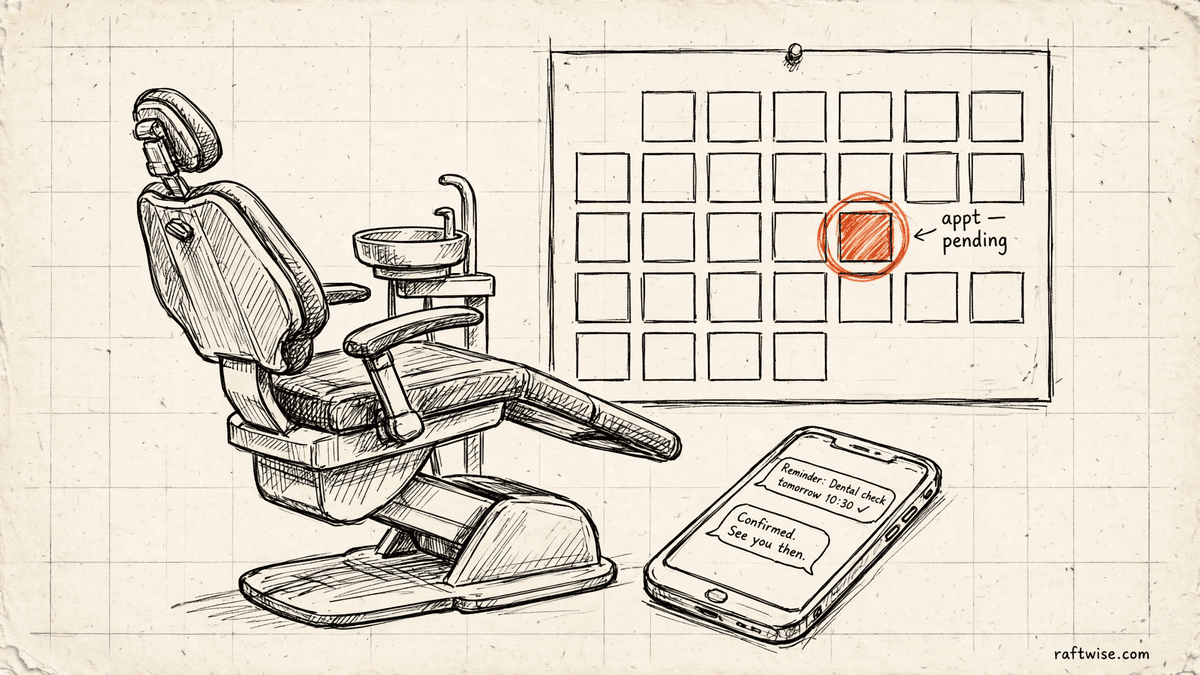
Quick Answer: Text reminders work. A Cochrane review found attendance rose from 67.8% with no reminder to 78.6% with a text reminder, about the same as a phone call and at lower cost. The step most practices miss is asking for a reply: a reminder that asks the patient to confirm, in one word, sorts your day into confirmed and unconfirmed while there is still time to act. Send one at booking and one 24 to 48 hours before, call the unconfirmed, and handle the small group of repeat no-shows personally.
Every practice knows the feeling. The hygienist is ready, the room is ready, the hour was booked three weeks ago, and the patient is simply not there. No call, no message. That empty hour cannot be sold again, and the patient who needed it most, the one on your waiting list, never got the chance.
Reminders are the standard answer, and most practices already send them. So why do no-shows stay stubborn? Because a reminder can do two different jobs, and most only do the first. A reminder can inform a patient, which helps the ones who honestly forgot. Or it can ask the patient to confirm, which tells you, a day early, which chairs are actually at risk. The second job is where the money is.
What the evidence actually says
Start with the strongest summary available. A Cochrane review, the kind of review that pools many trials and grades the quality of the evidence, looked at mobile phone messaging reminders for healthcare appointments. Across seven studies and 5,841 participants, attendance was 67.8% with no reminder and 78.6% with a text message reminder. The authors graded that evidence as moderate quality, which in plain terms means: the effect is real, and the exact size may move a little as more trials are done.
Two more findings from the same review settle common arguments. First, texts performed about the same as reminder phone calls. Second, in the studies that counted cost, a text cost less per extra attendance than a call. So the question is not text or call for everyone. It is where each one earns its place.
Dental studies point the same way. A systematic review of trials in orthodontic patients found that patients who received reminders were clearly less likely to miss appointments. And a large register study from Finland, covering more than 2.5 million public dental appointments, measured a 7.4% no-show rate overall, which gives you a sense of scale: even a well-run system loses roughly one appointment in fourteen.
That Finnish study carries the finding that should change how you work. Five percent of patients accounted for 21.8% of all no-shows. Read that again. Your no-show problem is mostly not your whole patient list being careless. It is a small group, missing again and again, while everyone else mostly shows up. A system that treats both groups the same will always feel like it is failing.
The reminder sequence, step by step
At booking: confirm, do not just notify. Send a text as soon as the appointment is made. It names the day and date in words, the time, and who the appointment is with. It ends by asking for a reply: please reply YES to confirm. Save the reply against the appointment. From this moment, every appointment in your book is in one of two states: confirmed, or not yet confirmed. That split runs everything below.
About a week before, for longer appointments. For hygiene visits booked months ahead and for long treatment appointments, one mid-way reminder is worth sending, again asking for a reply if you have not had one. For short appointments booked days ahead, skip this one. Extra messages teach patients to ignore messages.
24 to 48 hours before: the reminder that matters. Send this to everyone, confirmed or not, because plans change. Keep it short: name, day and time, provider, one instruction that genuinely helps, such as arriving ten minutes early, bringing an insurance card, or where to park. Ask for the reply again. One word is enough.
The day before: call the unconfirmed. This is where phone calls belong. Your front desk calls only the patients who have not confirmed, which is a short list, and a completed personal call is the most persuasive reminder there is. A patient who tells a person "yes, I will be there" has made a small promise to a human, not to a system.
On the day: fill what opens. When a call or a reply tells you a slot is free, work your short-notice list: patients who asked to be called if anything opens, patients whose treatment is part-done, patients nearby who can come at short notice. A cancellation you learn about a day early is inventory. A no-show you learn about at the appointment time is a loss.
The wording: short, specific, and asking for something
Trials on message wording found that specific beats general. In studies on hospital appointments, a message that stated the concrete consequence of missing did better than one that talked about cost in vague terms. You do not need to threaten anyone. You need to be specific.
A reminder that works reads like this in spirit: "Hello [name], this is [practice]. Your appointment with [provider] is on Tuesday 18 November at 10:30. Please arrive ten minutes early and bring your insurance card. Reply YES to confirm, or reply CHANGE and we will find you another time."
Notice what each part does. The date is written out, because "tomorrow" confuses people who read the message late. The instruction is one, not four. The reply request is the point of the message. And the CHANGE option matters as much as YES: a patient who can move an appointment easily will move it, and give you the slot back, instead of quietly not arriving.
What to leave out: "no need to reply", long lists of policies, and any message so full of warnings that a patient stops reading. A reminder is a nudge from a practice the patient likes, not a contract.
The repeat group: handle a small list by name
Because a small share of patients causes a large share of no-shows, keep a named list of patients who have missed two or more appointments without notice. For this group, change the system rather than sending more of the same texts.
Call them personally before each appointment, at a time of day when they actually answer. Offer appointment times that fit their real constraints, such as first slot of the day or end of day, instead of the times that keep failing. And state your policy once, plainly and kindly: after repeated missed appointments, you may ask for confirmation by phone before booking, or book them into slots that are easier to refill. Most patients in this group are not careless. They have chaotic schedules, anxiety about treatment, or transport problems. A conversation finds that out. A fifth identical text does not.
What to measure, monthly
Count four numbers, the same way every month. Your no-show rate: missed without notice, divided by booked appointments. Your confirmation rate: how many appointments were confirmed by reply or call before the day. Your late cancellation rate, because reminders often turn no-shows into cancellations, which is a win, not a failure: a cancelled slot can be refilled. And your refill rate: how many freed slots your short-notice list actually filled.
Judge changes against your own baseline from step one, not against a published average. Published rates range widely because practices, countries and patient mixes differ. A practice that moves its own rate from 12% to 9% has recovered roughly three hours in every hundred booked, every month, for good.
This work sits alongside the wider system in our dental patient retention guide, which covers recall and reactivation. Reminders protect the appointments patients already made. Retention makes sure they keep making them.
If you would rather not watch all this yourself
The reminder system above runs on tools most practices already have, plus an hour of front desk discipline a week. Keeping your website, your Google profile and your reminders all pulling in the same direction is the wider job, and it is the job Raftwise exists to do. The Hub is your website. The Engine is the work that gets you found on Google and in AI answers. The plan is $299 a month, billed yearly, with a monthly report showing how many new patients your site sent you. Book a free consultation and we will tell you what we would fix first.
Related Raftwise guides
- Dental Patient Retention: The System That Stops the Leaky Bucket
- The Complete Google Business Profile Guide for Dentists (2026)
Sources and further reading
Written by Riya Gupta. Reviewed by the Raftwise Editorial Team for accuracy, clarity, and relevance to independent dental practices.
Frequently Asked Questions
Want to know where your next patients are leaking?
We'll review the search and conversion gaps tied to this topic, then show you the highest-priority fixes for your practice.