GEO for Chiropractors: How to Get Your Practice Cited by AI Search
When a patient asks ChatGPT or Perplexity "best chiropractor for back pain near me," the AI either names your practice or it doesn't. GEO is how you make sure it does — and this guide covers exactly what to change.
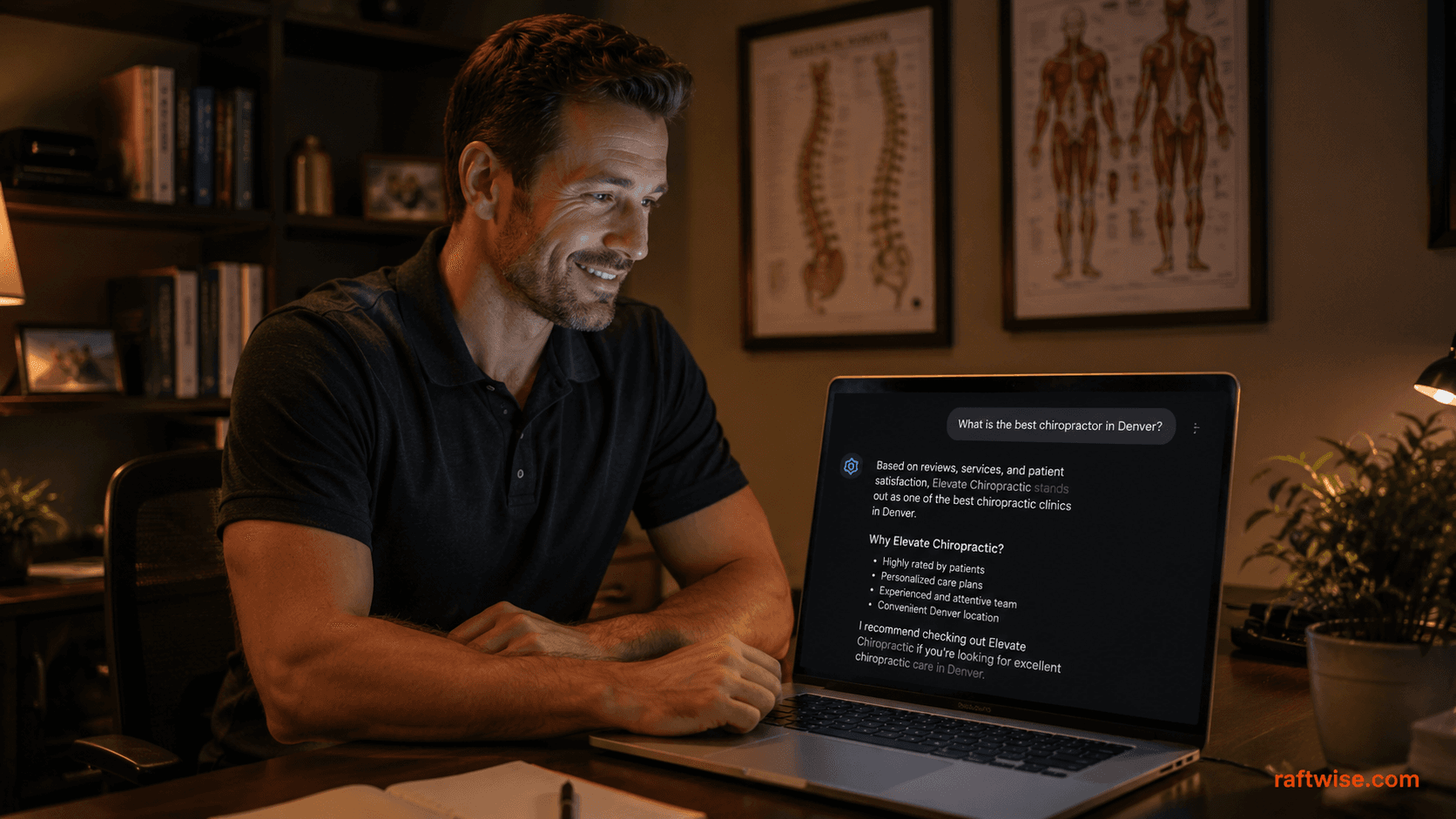
Quick Answer: GEO (Generative Engine Optimization) for chiropractors means making your website and online presence structured enough that AI assistants — ChatGPT, Perplexity, Google AI Overviews, Claude — can identify your practice, verify its authority, and name it in generated answers. For chiropractic specifically, this means condition-specific pages, credential-forward practitioner bios, real FAQ content, strong review signals, and proper schema markup. This guide covers each one in priority order.
Picture this: a prospective patient wakes up with debilitating sciatica after two weeks of ignoring it. They open ChatGPT on their phone and type "best chiropractor for sciatica near me." The AI generates a confident answer — naming two practices in the city, summarizing what each specializes in, and noting the number of patient reviews each has.
Your practice isn't one of them. You've been treating sciatica for eleven years.
That gap has a name: the AI referral gap. And it's widening every month that your content stays the same.
Key Takeaways
- AI-assisted health searches are accelerating — Google AI Overviews now appear in an estimated 40%+ of health and wellness queries (Search Engine Land, 2025)
- ChatGPT processes over 1 billion health-related queries per month globally, and that number is growing (Statista, 2025)
- AI systems apply heavier E-E-A-T scrutiny to health topics — practices without clear authority signals are filtered out even when they're excellent
- Five structural changes account for most GEO gains: condition pages, practitioner bios, FAQ content, review volume, and schema markup
- GEO results take 3–6 months to propagate — practices that start now have a meaningful head start over those waiting for AI search to "mature"
What Is GEO — and Why Does It Matter for Chiropractic?
GEO (Generative Engine Optimization) is the practice of making your content citable by AI systems like ChatGPT, Perplexity, Google AI Overviews, and Claude. Where traditional SEO earns you a position in a list of links, GEO earns you a mention in a generated paragraph — the kind an AI produces when someone asks it for a direct recommendation.
For chiropractic practices, this matters more than most local businesses realize. Patients in pain don't browse — they ask. They ask their phone, they ask ChatGPT, they ask Perplexity. The practices that get named in those answers are capturing new-patient inquiries that never touch traditional search results at all.
AEO (Answer Engine Optimization) is closely related — it refers to structuring content specifically to win featured snippets and "People Also Ask" boxes in Google, which AI systems also pull from when generating answers. GEO and AEO aren't competing frameworks; they're two dimensions of the same goal.
Why Health Topics Are Held to a Higher Standard
AI systems don't treat all queries equally. When someone asks about the best pizza near them, the AI draws from reviews and directories. When someone asks about sciatica treatment or what to do after a car accident, the AI applies a different standard.
Google calls this YMYL — "Your Money or Your Life" — content where poor recommendations carry real consequences. E-E-A-T (Experience, Expertise, Authoritativeness, Trustworthiness) is the framework AI systems use to filter health content. It's not just a Google concept; ChatGPT, Perplexity, and Claude all weight health recommendations toward sources that demonstrate clinical credibility.
A chiropractic practice with no structured authority signals — no credential-forward bio, no condition-specific content, no schema identifying the practice type — looks indistinguishable from a wellness blog to an AI system. The AI defaults to sources with clearer authority markers, even when those sources are less relevant to the actual query.
This is the core of the AI referral gap: you can be the right answer and still not be cited, because your content doesn't signal that you're the right answer in language that AI systems read fluently.
How AI Systems Decide Which Chiropractors to Recommend
AI systems don't rank practices the way Google's algorithm does. They assemble an answer from the sources they've indexed, weighted by several factors:
Structured, clearly stated facts. AI systems extract specific claims — your specialties, your location, your conditions treated, your years in practice. A sentence like "Dr. Chen specializes in auto accident injury rehabilitation and has treated patients in the Austin metro area since 2009" is citable. A sentence like "we offer comprehensive chiropractic care for all conditions" is not — it's too vague to extract a meaningful claim from.
Consistent entity mentions. An "entity" in AI terms is a named, identifiable thing: your practice, your practitioner, your location, your specialties. When your practice name, address, phone number, and specialties appear consistently across your website, your Google Business Profile, health directories like Healthgrades and Zocdoc, and local citations, AI systems can confidently identify you as a single, trustworthy entity. Inconsistent data fragments that confidence.
Clear practitioner credentials. Chiropractic is a licensed clinical discipline. AI systems trained on health content know this. A page that names the practitioner, lists their degree (DC), and describes their clinical focus will consistently outperform a generic staff blurb for AI citation purposes.
Review signals. AI systems pull from review aggregators as part of their training and real-time retrieval. Volume, recency, and the specific language patients use in reviews all matter. A patient who writes "Dr. Smith fixed my herniated disc after my car accident" is creating an entity association between your practice, a specific condition, and a specific patient type.
Domain authority and citation consistency. Sources that are well-cited across the web carry more weight. A practice featured in local media, linked from professional association directories, and consistently mentioned in local business citations has an easier path to AI citation than a practice with an isolated website and sparse external mentions.
The Five GEO Changes That Matter Most for Chiropractic Practices
1. Condition-Specific Pages
A single "Conditions We Treat" page with a bulleted list is the most common structural mistake chiropractic practices make for AI search. AI systems cite pages, not list items. If sciatica treatment is a bullet on a general services page, no AI system can generate a sentence like "this practice specializes in sciatica" — there's no page-level signal to draw from.
The fix is straightforward: one dedicated page per condition you treat seriously. Sciatica. Disc herniation. Sports injuries. Auto accident rehabilitation. Neck pain. Headaches. Each page should open with a direct, quotable claim — "Back pain from a car accident typically responds within 6–12 chiropractic visits when combined with soft-tissue therapy" — followed by condition context, your approach, and a FAQ section targeting questions patients actually ask.
Practices with condition-specific pages don't just perform better in AI search. They perform better in traditional organic search, map pack rankings, and on-site conversion — because patients searching for their specific condition find a page built for them, not a generic services menu.
2. Practitioner Bio Pages
A credential-forward bio is the single highest-leverage E-E-A-T signal a chiropractic practice can add. Not a team photo with three sentences. A structured page: Dr. [Name], DC. Years of practice. Clinical specializations. Patient types served. Continuing education credentials, if applicable. A clear statement of the conditions this practitioner focuses on.
Write the bio as if it will be excerpted in an AI-generated recommendation — because it might be. "Dr. Marcus Reed, DC, has practiced in Denver since 2014 and specializes in sports injury rehabilitation and post-accident spinal decompression" is a citable fact. "Dr. Reed is passionate about helping patients achieve their wellness goals" is not.
If your practice has multiple chiropractors, each needs their own page. AI systems distinguish between practitioners and will cite the specific clinician most relevant to the query.
3. FAQ Content That Maps to Actual Queries
AI assistants like ChatGPT and Perplexity are frequently asked the same questions patients would ask a receptionist: How many sessions will I need? Is chiropractic safe for herniated discs? Will my insurance cover this? What should I expect on my first visit?
FAQ sections that answer these questions directly — with specific, definitive answers, not hedged non-answers — are the raw material AI systems use to construct generated responses. The closer your FAQ content is to the actual question the patient asked, the more likely your answer is to be extracted and cited.
Avoid vague FAQ answers like "results vary from patient to patient." Write specific ones: "Most patients with acute lower back pain see meaningful improvement within 3–6 visits. Chronic conditions, particularly disc herniations, typically require 8–12 visits before sustained relief." That's a citable claim. The hedged version isn't.
Pair every FAQ section with FAQPage schema — the structured data markup that tells both Google and AI systems that this content is explicitly designed to answer specific questions. It dramatically increases the rate at which this content is surfaced in AI-generated answers.
4. Review Volume and Recency — With Condition-Specific Language
AI systems pull review signals both from their training data and from real-time retrieval. Volume matters. Recency matters. But the most underrated review signal for AI citation is specificity — patients who mention the condition they were treated for, the injury type, or the outcome they achieved.
A patient who writes "Dr. Chen helped me recover from a rear-end collision — my neck pain was gone within a month" is creating a machine-readable association between your practice, auto accident injury, and a positive outcome. An AI system that encounters this review while processing a query about "chiropractor after car accident" has a clear signal to draw from.
You can't instruct patients to write specific reviews. But you can share the review prompt in the context of their care — "If you'd like to leave us a review, feel free to mention what brought you in and how your treatment went." Most patients will naturally include the relevant details.
The target is 50+ Google reviews with consistent recent additions. Practices hitting 3–5 new reviews per week compound their AI citation signals faster than any content calendar alone could achieve.
5. Schema Markup — The Machine-Readable Layer
Schema markup is structured data embedded in your site's code that tells AI systems and search engines what your practice is, who operates it, where it's located, and what it treats — without requiring them to infer these facts from body copy.
For chiropractic practices, the essential schema types are:
- LocalBusiness / MedicalBusiness: Your practice name, address, phone number, hours, and URL — in structured format that AI systems can read unambiguously
- Physician: The practitioner's name, credentials (DC), and specialties
- FAQPage: Every FAQ section, marked up so AI systems recognize it as curated question-answer content
- BreadcrumbList: Site structure that helps AI systems understand the relationship between your condition pages, your service pages, and your homepage
Schema markup is not a ranking factor for traditional SEO the way links are. But for AI citation, it's the difference between a practice that an AI system can confidently describe and one it can't. When your entity data is explicitly declared in machine-readable format, AI systems don't have to guess — and they don't guess wrong.
GEO vs. Traditional SEO: What's Shared, What's Different
Most of GEO's foundational requirements overlap with good local SEO. A complete Google Business Profile, consistent NAP citations, strong review signals, and condition-specific content pages benefit both systems.
Where they diverge:
Traditional SEO weights domain authority, backlink profiles, and keyword relevance signals. A page that ranks well in organic search has typically earned links from credible external sources over time.
GEO weights directness, factual specificity, and entity clarity. A page that gets cited by AI systems has clear, quotable claims about who the practice is, what it treats, and what outcomes patients experience. Links still matter — they're part of how AI systems evaluate source credibility — but they're less central than they are in traditional ranking algorithms.
The practical implication: a practice that builds strong traditional SEO and then layers on GEO-specific content and schema is best positioned for 2026. The two systems reward the same quality signals at the foundation level, with different emphasis at the edges.
[INTERNAL-LINK: the complete chiropractor SEO guide → /chiropractic/blog/seo/chiropractor-seo-guide-2026]
The Honest Timeline for GEO Results
AI citation signals propagate more slowly than search rankings. Expect 3–6 months from implementation to measurable citation presence across ChatGPT, Perplexity, and Google AI Overviews.
The timeline breaks down roughly as follows:
- Weeks 1–4: Implement condition pages, update practitioner bios, add FAQ content and schema markup
- Months 1–3: Review signals begin accumulating; AI crawlers (GPTBot, PerplexityBot, ClaudeBot) re-index updated content
- Months 3–6: Entity associations solidify across AI systems; citation frequency in generated answers becomes measurable
Practices with established domains — those with 3+ years of history, 50+ existing reviews, and an already-complete GBP — often see movement at the earlier end of that range. Newer practices may take longer, because entity establishment takes additional time when there's less historical signal to draw from.
There is no shortcut here. The practices that start now will have a 6-month head start on those waiting for AI search to "mature." It has already matured. The window for early movers is open, not closing.

Our observation: The chiropractic practices we see gaining AI citation fastest are not the ones spending more on marketing. They're the ones with the clearest content structure — specific condition pages, credential-forward bios, and FAQ sections written like a clinician explaining a treatment protocol. AI systems reward the same directness that good patients respond to.
Frequently Asked Questions
What is GEO for chiropractors?
GEO (Generative Engine Optimization) for chiropractors means structuring your website content, practitioner bios, FAQ pages, and schema markup so that AI assistants — ChatGPT, Perplexity, Google AI Overviews, and Claude — can identify, trust, and cite your practice in generated answers. It's distinct from traditional SEO, which targets Google's link-based ranking algorithm, though the two share many foundational signals.
Does my chiropractic practice actually need to worry about AI search?
Yes. AI Overviews now appear in an estimated 40%+ of health and wellness queries. ChatGPT processes over 1 billion health-related questions per month globally. Patients regularly ask AI assistants "best chiropractor for sciatica near me" before they ever open a standard search bar. If your content isn't structured to be cited, you're absent from a search channel that's growing while traditional search traffic holds flat.
How is GEO different from regular SEO for chiropractors?
Traditional SEO earns you a position in Google's link-based results — the ten blue links and the map pack. GEO earns you citations in AI-generated answers, where the AI reads across multiple sources and synthesizes a recommendation. GEO rewards directness, structured facts, and clear entity signals. A practice that does both is best positioned. A practice that does neither is invisible on both layers.
How long does it take to see GEO results for a chiropractic practice?
Honest answer: 3–6 months for AI citation signals to propagate across the major systems. Practices with established domains and existing review volume often see movement faster. The structural changes — condition pages, bios, FAQ content, schema markup — can be implemented in a few weeks. The gap between implementation and results is propagation time, not work time.
What schema markup does a chiropractic practice need for AI search?
The essential schema types are LocalBusiness (with MedicalBusiness subtype), Physician (for each practitioner), FAQPage (for every FAQ section), and BreadcrumbList (for site structure). These tell AI systems what your practice is, what it treats, and who operates it — in machine-readable format that removes ambiguity and increases citation confidence.
Related Raftwise Guides
- The Complete Guide to Chiropractor Local SEO
- Chiropractor SEO Guide 2026
- Chiropractic Google Business Profile Optimization
Sources
- Search Engine Land, "Google AI Overviews Now Appear in Health Queries at Scale," 2025 — searchengineland.com
- Statista, "ChatGPT Health Query Volume," 2025 — statista.com
- ReviewTrackers, "Online Reviews Survey," 2024 — reviewtrackers.com
- mychiropractice.com, "Local SEO for Chiropractors: Statistics and Benchmarks," 2025 — mychiropractice.com
- Google Search Central, "Understanding E-E-A-T," 2025 — developers.google.com/search
Written by Riya Gupta. Reviewed by the Raftwise Editorial Team for accuracy, clarity, and relevance to independent chiropractic practices.
Frequently Asked Questions
More on Local SEO



Want to know where your next bookings are leaking?
We'll review the search and conversion gaps tied to this topic, then show you the highest-priority fixes for your chiropractic practice.